How to Manage Your PR Team Without a PR Agency?
Managing public relations in-house may seem complex, but it is becoming the norm. According to the USC Annenberg Center for Public Relations, over 60% of companies now handle at least part of their PR internally instead of relying entirely on agencies.
While this shift gives businesses more control, speed, and authenticity, it also introduces new challenges — from coordinating press releases to maintaining a centralized, media-ready newsroom. This is where tools like SubPage help streamline PR workflows, making it easier for teams to manage communication, collaboration, and coverage in one place.
This guide walks you through what a PR team is, what it does, and how to manage it effectively without depending on an external agency.
What is a PR team?
A PR team is an internal group of professionals responsible for managing a company's public image, media relationships, press communications, and brand narrative. Unlike a PR agency — which works with multiple clients simultaneously — an in-house PR team is fully dedicated to your brand.
A typical PR team includes roles such as:
PR Manager or Head of Communications, Media Relations Specialist, Content and Press Release Writer, Social Media and Brand Communications Lead, Crisis Communications Advisor (sometimes shared with legal)
Each role contributes to building and protecting the company's reputation across media channels, stakeholder audiences, and the public domain.
Why managing your PR team in-house makes sense
Hiring a PR agency can cost anywhere from $5,000 to $20,000 per month. Beyond the financial argument, in-house PR teams offer several distinct advantages:
- Deeper brand knowledge: Your team lives and breathes the brand daily. Faster turnaround: No agency briefings, no delayed approvals — your team moves at the speed of your business.
- Authentic storytelling: Internal PR teams tell stories that feel genuine because they come from within. Consistent relationships: Media relationships built by your team are owned by your company, not the agency.
For more on how content-driven PR builds brand authority, read How blog content helps in building brand authority.
How to structure your PR team
The structure of your PR team will depend on your company's size, industry, and communication goals. Here is a simple framework to get started:
- For small businesses (1–3 people): Hire a generalist PR manager who handles media outreach, press releases, and social communications. Support them with a part-time content writer.
- For mid-size companies (4–8 people): Divide responsibilities into media relations, content, and digital PR. Assign a team lead who owns stakeholder communication.
- For scaling companies (8+ people): Add specialists for crisis communications, analyst relations, and regional PR as your media presence grows.
Regardless of size, every PR team needs a shared workspace — a place where press coverage, press releases, brand assets, and media mentions are centralized and accessible.
The role of collaboration in PR team management
One of the biggest operational challenges for any in-house PR team is collaboration. PR work is inherently multi-person — a press release is drafted by one person, reviewed by the communications lead, approved by the founder or marketing head, and then published. Without a proper collaboration workflow, things get lost in email threads, Slack messages, and shared drives.
This is where SubPage makes a tangible difference. SubPage's collaboration feature allows your entire PR team to work on newsroom content together in real time. Multiple team members can co-edit press releases, review drafts, manage publishing timelines, and maintain version history — all without toggling between different tools.
Collaboration on SubPage is designed for PR workflows specifically:
Team members can be assigned roles — editors, reviewers, and publishers — so the right people handle the right stages of the content lifecycle. Comments and feedback can be added directly to press content without sending separate review emails. Changes are tracked, and version history is maintained, so nothing gets accidentally overwritten.
For fast-moving PR teams, especially those managing multiple media touchpoints simultaneously, this kind of structured collaboration is not a nice-to-have — it is essential.
How to manage your PR team effectively
Managing a PR team without an agency means you take on the strategic and operational load that agencies typically carry. Here is how to do it well:
Set clear communication goals — Define what success looks like. Is it media mentions per month? Press release pickups? Share of voice in your industry? Clarity on goals gives your team direction and makes performance measurable.
Build a media calendar — Plan your PR activity in advance. Tie press releases, product announcements, and earned media efforts to your product roadmap and business milestones.
Own your media relationships — Encourage your team to build genuine relationships with journalists, analysts, and editors. These relationships are long-term assets.
Create a centralized newsroom — Make it easy for journalists and media contacts to find press releases, brand assets, media kits, and team contacts. A well-maintained newsroom reduces friction for the press and improves your chances of coverage.
Standardize press release workflows — Use templates and editorial guidelines to maintain consistency. Align on tone, structure, and approval processes so your team is not reinventing the wheel every time.
For a deeper dive into press communications, check out How AI is changing the way companies write press releases and What is a business newsroom and why does every company need one?.
Auto fetch mention: never miss a media hit
One of the most powerful features in SubPage's newsroom is Auto Fetch Mention. When your brand earns media coverage — a blog mention, a news article, a podcast feature — tracking it manually is time-consuming and unreliable.
SubPage's Auto Fetch Mention feature automatically pulls in external mentions of your brand from across the web and surfaces them directly in your newsroom. Your PR team no longer needs to manually Google your brand name or set up separate monitoring tools. Every time your company is mentioned online, it gets logged and displayed in your newsroom automatically.
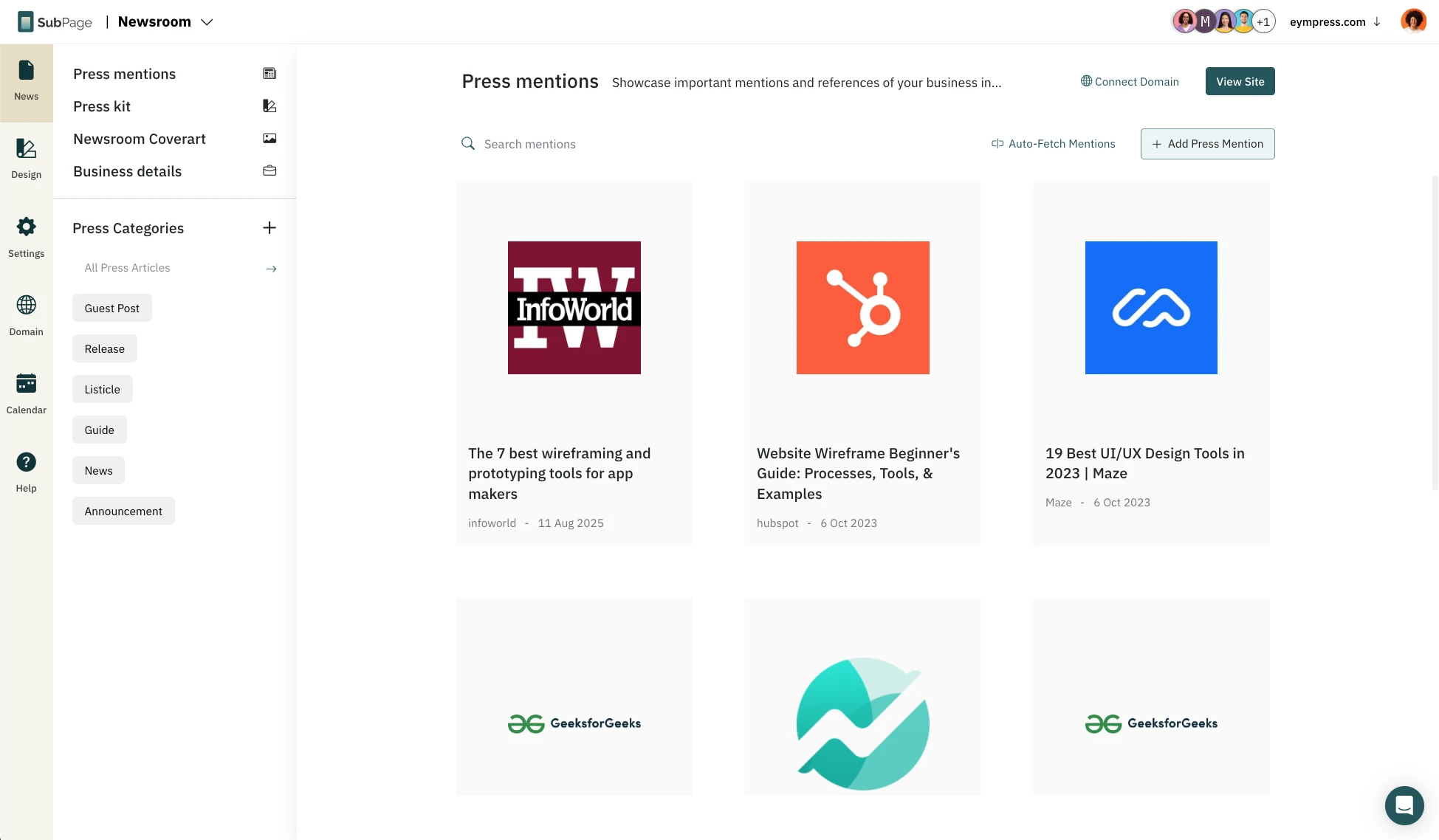
This feature is particularly valuable for:
Monitoring earned media coverage without manual effort, building a live archive of press mentions that journalists and investors can see, helping your PR team quickly identify which pitches and stories are gaining traction, and creating social proof directly on your public newsroom page
Rather than paying for expensive media monitoring software as a separate line item, SubPage bundles this capability directly into your newsroom — making it a cost-effective choice for lean PR teams.
How SubPage helps your PR team operate independently
SubPage is a no-code platform designed to help businesses build and manage essential website pages — including a fully functional newsroom — without developer dependency.
Here is what SubPage offers a PR team specifically:
- Newsroom builder: Create a professional, press-ready newsroom that houses press releases, media coverage, brand assets, and executive bios in one place. Collaboration tools: Work as a team with role-based editing, review workflows, and in-platform commenting — all designed to eliminate the chaos of PR-by-email.
- Auto Fetch Mention: Automatically aggregate media mentions from across the web into your newsroom, keeping your coverage archive always up to date.
- No-code publishing: Draft, edit, and publish press releases directly from SubPage without needing engineering or IT support. Custom branding: Your newsroom looks like it belongs to your brand — not a third-party tool.
For context on how a proper newsroom builds credibility with external audiences, read How a newsroom page builds trust with investors, partners, and customers.
Common mistakes to avoid when managing an in-house PR team
Even well-structured PR teams make avoidable mistakes. Here are the most common ones:
- Reactive PR only: Waiting for news to happen before communicating. Build a proactive calendar.
- No crisis plan: Every company faces reputation challenges. Have a documented crisis communications protocol before you need it.
- Siloed content: Press releases and media content that live in one team member's inbox are a liability. Centralize everything.
- Inconsistent brand voice: Different team members writing in different styles. Invest in brand voice guidelines early.
- Ignoring media relationships: PR is a relationship business. Make journalist outreach a recurring activity, not an afterthought.
Conclusion
Managing your PR team without a PR agency is not just possible — for many companies, it is the smarter, more sustainable choice. With the right structure, clear goals, and the right tools, your in-house team can build stronger media relationships and tell a more authentic brand story. SubPage gives your PR team everything they need — from a professional newsroom and team collaboration to Auto Fetch Mention that keeps your coverage always current. Get started with SubPage for free →
