How a Newsroom Page Builds Trust With Investors, Partners, and Customers
Trust has become one of the most valuable — and measurable — assets a business can hold. According to Accenture's 2025 Life Trends report, 62% of people say trust is an important factor when choosing to engage with a brand.
That gap is a communication problem — and a newsroom page is one of the most effective tools to close it.
A newsroom page is a dedicated section of your website that houses press releases, media coverage, company announcements, leadership news, and press contacts in one structured, professional hub. It signals that your company is active, accountable, and media-ready. And for three audiences in particular — investors, partners, and customers — a newsroom page carries outsized weight in shaping perception.
What is a newsroom page, and why does it matter
A newsroom page is more than a press release archive. It is a living, curated record of your company's trajectory — where you've been covered, what milestones you've reached, and how you communicate publicly.
Unlike a blog, which serves content marketing goals, a newsroom page is specifically built for credibility. It tells a journalist, investor, or potential partner: "We are a serious, transparent organization with a documented history."
Companies that maintain a structured newsroom page are significantly more likely to earn organic press coverage because journalists can quickly find what they need — press contacts, media assets, and official statements — without having to chase down a PR team.
How a newsroom page builds trust with investors
Investors do not fund products alone — they fund companies, leadership teams, and momentum. When an investor visits your website and finds a well-maintained newsroom page, it immediately reduces perceived risk. Here's why:
- Proof of traction. A newsroom filled with announcements, funding rounds, partnerships, and award recognitions tells a story of forward motion. Investors are pattern-matching machines, and a newsroom with activity signals that things are happening.
- Transparency and governance. In 2024, terms like "transparency" and "governance" dominated financial press releases, according to PR trend analysis from Sprinklr. Investors increasingly expect companies to communicate proactively and publicly — not just during fundraising.
- Verifiable credibility. Third-party media coverage listed on your newsroom page carries far more weight than anything you say about yourself. A Forbes mention, a TechCrunch feature, or an industry award listed on your newsroom page becomes social proof that independent parties have recognized your company.
- Consistent narrative. Investors often review multiple touchpoints before making a decision. A newsroom page allows you to control and unify your public narrative so that every press release, interview quote, and announcement is consistent with your brand positioning.
How a newsroom page builds trust with partners
When companies evaluate potential business partners, they conduct due diligence. That research almost always starts online — and your newsroom page is often a first stop.
A well-structured newsroom page answers the unspoken questions partners have:
- Is this company stable and growing?
- Have other credible companies worked with them?
- Do they communicate professionally?
- What does the press say about them?
- Partnership announcements build momentum. When you publish a press release announcing a new integration, a distribution deal, or a co-marketing initiative, it creates a public record of collaborative activity. Prospective partners see that others trust you enough to work with you — which makes them more likely to do the same.
- Press contacts reduce friction. A newsroom page with clearly listed press contacts makes it easy for media and potential collaborators to reach the right person immediately. Friction in communication is a trust-killer; removing it signals professionalism.
- Brand kit accessibility. Many newsroom pages include a brand guide or press kit — logos, product screenshots, approved copy — which makes it easy for partners to represent your company accurately in co-marketing materials. This protects brand integrity and shows that you've thought ahead.
How a newsroom page builds trust with customers
Customers today research companies extensively before buying. According to Accenture's findings, over half of people are questioning the content they encounter online more than ever before — and 74% prioritize a company's reputation and trustworthiness when deciding whether to engage, per a 2025 Okta/Auth0 customer identity study.
A newsroom page gives customers visible evidence that your company is real, legitimate, and recognized.
- Press coverage as social proof. When a customer sees that your company has been featured in recognized publications, it functions as third-party validation. You didn't say you were great — someone else did.
- Announcements that signal stability. Product launches, funding announcements, and hiring news all signal that the company is growing and investing. For customers making a significant purchase or signing a long-term contract, stability matters.
- Transparency builds loyalty. Customers who feel informed are more loyal. A newsroom page that shares company updates — including challenges, pivots, and honest communications — creates a sense of openness that keeps customers engaged beyond the transaction.
What a high-trust newsroom page should include
Not all newsroom pages are equal. The ones that consistently build trust share several structural elements:
- Press releases are organized chronologically. A clear timeline of announcements allows visitors to understand your company's history and momentum at a glance.
- Media coverage section. Curated links to third-party press mentions, with publication logos displayed, amplify credibility significantly.
- Press contacts. A dedicated PR contact name, email, and ideally a photo removes any ambiguity about how to reach your communications team.
- A press kit or brand guide. Logos, product images, approved bios, and boilerplate company descriptions save journalists and partners time — and help ensure your brand is represented accurately.
- Company milestones and awards. Recognitions, certifications, and major achievements belong in the newsroom, not buried on an About page.
- Founder or leadership quotes. Attaching a named voice to announcements adds authority and humanizes the company.
How SubPage helps you build and manage a newsroom page
Building a professional newsroom page used to require a developer, a CMS integration, and significant setup time. SubPage changes that entirely.
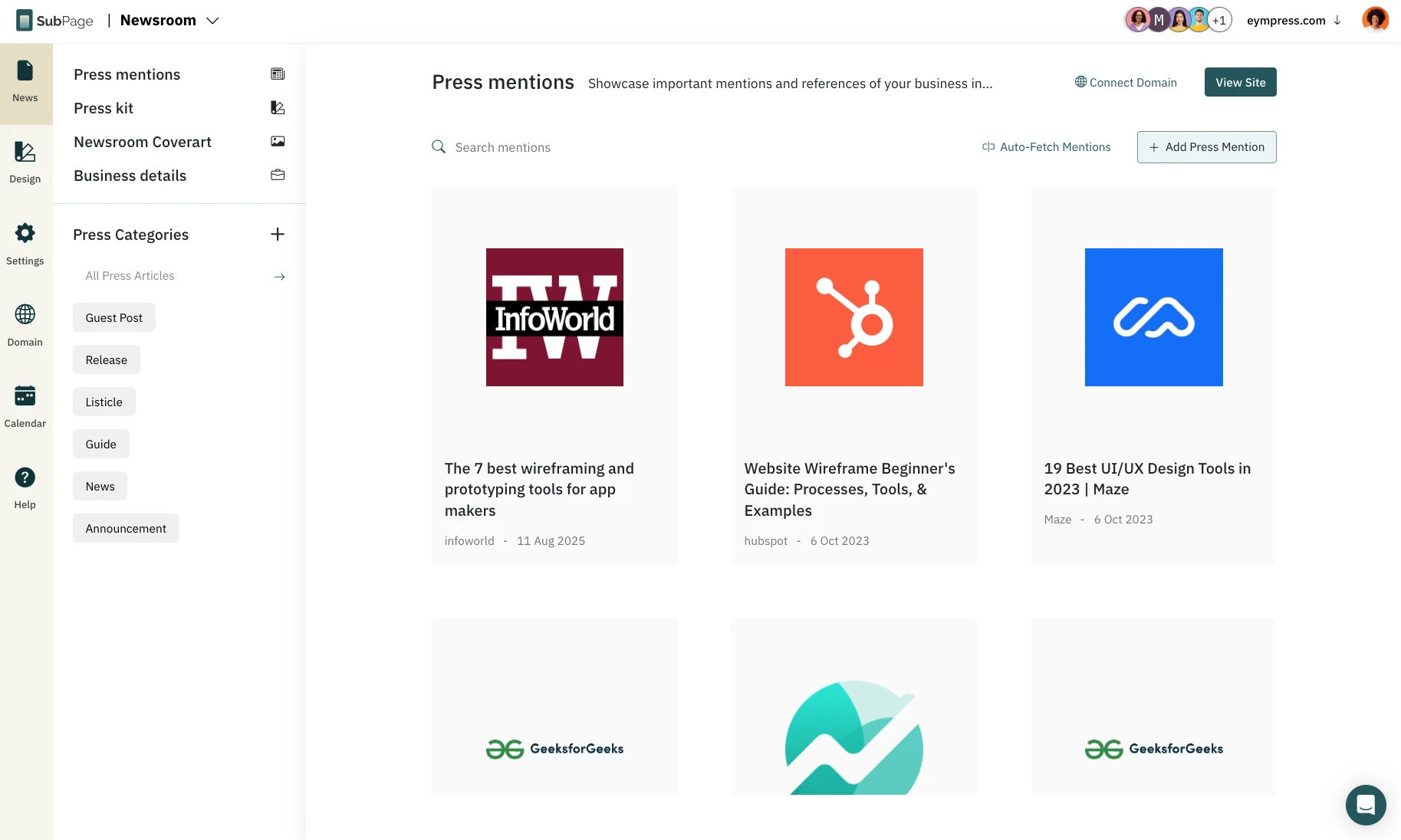
SubPage's newsroom builder is designed specifically for businesses that need a press-ready, professional newsroom page without code. Here's what makes it stand out:
- Newsroom-focused layouts. SubPage offers purpose-built layouts designed for press pages — not generic website templates repurposed for a newsroom. You can switch between professional layout options anytime to match your brand's evolving identity.
- Auto-fetch press mentions. One of SubPage's most distinctive features is its ability to automatically search and surface recent mentions of your business from across the web. You can review and add these mentions directly to your newsroom, saving your PR team hours of manual curation.
- Branded customization. Add your logo, set your brand colors, choose your typography — all without touching a line of code. Your newsroom page will look like an extension of your main website, not an afterthought.
- Press kit and contact sections. SubPage includes dedicated modules for your press kit (downloadable assets for journalists) and press contacts (named contacts with email and role), making your newsroom truly media-ready.
- AI-powered content creation. Creating press releases, writing announcement copy, or drafting executive quotes is faster with SubPage's built-in AI writing tools. Both text and image generation are available inside the editor.
- Team collaboration. Bring your PR team into the SubPage editor to manage, draft, and publish newsroom content collaboratively — with role-based access so the right people control what goes live.
- Free to start. SubPage offers a free plan that lets you publish up to 10 press releases and connect your custom domain — enough to get a credible newsroom page live today without any upfront investment.
Common mistakes that undermine newsroom credibility
Even companies that build a newsroom page sometimes undercut its effectiveness. Here are the patterns to avoid:
- Leaving it empty or outdated. An empty newsroom is worse than no newsroom — it signals inactivity. The last date on your press releases matters. Aim for at least one update per quarter.
- No press contact information. If a journalist can't figure out who to email, they'll move on to a competitor who makes it easy.
- Only self-written content. A newsroom filled exclusively with your own press releases and no external coverage is a missed opportunity. Curating third-party media mentions builds far more credibility.
- Burying it in site navigation. Your newsroom page should be findable in your footer, and ideally in your main navigation under "Company" or "Media." If visitors can't find it, it can't build trust.
- No visual identity alignment. A newsroom that looks visually inconsistent with the rest of your website signals disorganization. Consistent branding matters.
