How AI is Changing the Way Companies Write Press Releases
Press releases have been a core part of business communication for decades. But the way companies write, manage, and distribute them is shifting faster than ever. According to Cision's State of the Media report, over 70% of journalists say press releases are still their preferred format for receiving company news — yet most releases never get picked up simply because they are poorly written, poorly structured, or sent to the wrong people at the wrong time.
If you have ever wondered why your announcements go unnoticed, the answer is usually in the craft, not the news itself. This guide walks you through exactly how to write a press release that gets read, and explores how AI is quietly transforming the entire process for modern communication teams.
What is a press release?
A press release is a short, structured document that a company sends to journalists, editors, and media outlets to announce something newsworthy. It follows a specific format designed to communicate the who, what, when, where, and why — clearly and quickly — so a busy journalist can decide in seconds whether it is worth covering.
Press releases are used for a wide range of announcements: product launches, funding rounds, executive hires, partnerships, events, company milestones, and crisis responses. The common thread is that they are written to inform the media and, by extension, the public.
What makes a press release different from a blog post or social media update is its formality, its structure, and its audience. A press release is not written for your customers — it is written for the media, with the goal that the media will then write for your customers.
The core structure of a press release
Every effective press release follows the same foundational structure. Deviating from it is one of the fastest ways to lose a journalist's attention.
Headline
This is the single most important line you will write. It should tell the entire story in one sentence — clearly, specifically, and compellingly. Avoid clever wordplay that obscures meaning. Journalists skim dozens of releases a day. Your headline needs to tell them instantly what happened and why it matters.
Dateline
The dateline appears at the beginning of the first paragraph and includes the city of origin and the release date. For example: London, May 27, 2026 —. It signals when and where the news is coming from.
Lead paragraph
The lead paragraph does the heavy lifting. It must answer the five Ws — who, what, when, where, and why — in two to three sentences. If a journalist reads only this paragraph, they should understand the full story. This is not the place for background or context; that comes later.
Body paragraphs
The body expands on the lead using the inverted pyramid structure: the most important information comes first, followed by supporting details, and ending with background context. Each paragraph should add new information, not repeat what came before.
This is where you include supporting data, details about the product or event, and any relevant context that gives the story depth.
Quotes
A good press release includes one or two quotes from a relevant spokesperson — typically a founder, CEO, or senior leader. The quote should add a human perspective or strategic insight that plain facts cannot. It should not simply restate what the previous paragraph said. Journalists often use quotes directly in their coverage, so make them count.
Boilerplate
The boilerplate is a short, standard paragraph at the end of every press release that describes your company — what it does, where it operates, and any key facts worth knowing. It stays consistent across all your releases and is always positioned just before the contact information.
Media contact details
End every press release with the name, email address, and phone number of the person journalists should contact for follow-up. Make this easy to find and make sure the person listed is actually available to respond quickly.
Common press release mistakes to avoid
- Even well-intentioned teams consistently make the same errors that reduce the impact of their announcements.
- Leading with the company name instead of news. Opening with "XYZ Inc., a leading provider of..." is one of the most common mistakes. Lead with the news, not your brand.
- Writing for customers instead of journalists. A press release is not a marketing brochure. Avoid superlatives, sales language, and promotional tone. Write factually and let the news speak for itself.
- Burying the lead. Placing the most newsworthy information three paragraphs in is a guaranteed way to lose the reader. Get to the point immediately.
- Overloading with jargon. Industry-specific language might resonate with your team, but journalists covering multiple beats may not understand it. Write for a smart, general reader.
- Sending without a clear news angle. Not everything is newsworthy. Before writing a release, ask honestly: would a journalist's audience care about this? If the answer is uncertain, consider whether a blog post or a social media update would serve better.
How to write a press release step by step
Step 1: Define the news angle
Before writing a single word, get clear on why this news matters to an outside audience. The stronger and more specific your angle, the easier every other step becomes.
Step 2: Write the headline last
Counterintuitively, the headline is often easier to write after the body is complete. Write the release first, then distill its core message into a single, punchy line.
Step 3: Draft the lead paragraph first
Start with the five Ws. Who is this about? What happened? When did it happen? Where? Why does it matter? Answer all five in two to three clear sentences.
Step 4: Build out the body with the inverted pyramid
Arrange information from most to least important. Supporting details, data points, and additional context come after the critical facts — not before.
Step 5: Add a strong, specific quote
Write a quote that sounds like a real person speaking — not a corporate statement. A quote like "This partnership opens up an entirely new market for us" is far more useful to a journalist than "We are pleased to announce this exciting collaboration."
Step 6: Write the boilerplate
Keep this to three to four sentences. It should describe what your company does and who it serves, with no fluff.
Step 7: Review for clarity, length, and tone
A good press release is typically 400 to 600 words. Anything longer risks losing attention. Edit ruthlessly — every sentence should earn its place.
Step 8: Publish to your newsroom
Your press release should live on your company's own newsroom page before it goes anywhere else. A well-maintained newsroom gives journalists a single, reliable source for all their news, past and present.
How AI is changing the way companies write press releases
The press release has not changed structurally in decades — but the process of writing one is transforming rapidly. AI is entering the workflow at every stage, from drafting to distribution.
Drafting and tone adjustment
AI writing tools can now generate a complete first draft of a press release in seconds from a short brief. More usefully, they can adjust the tone, reading level, and emphasis based on the target publication or journalist. A release aimed at a tech publication reads differently from one aimed at a regional business outlet — AI can produce both versions from the same source content.
Headline and angle generation
One of the hardest parts of press release writing is crafting a headline that is both specific and compelling. AI tools can generate dozens of headline options from the core facts of your announcement, giving your team a strong starting point rather than a blank page.
Consistency across a large content volume
For companies that publish press releases frequently — product updates, quarterly results, event announcements — maintaining consistent structure, tone, and boilerplate across every release is a real operational challenge. AI helps teams enforce consistency without slowing down the process.
Faster newsroom publishing
Modern newsroom tools with built-in AI allow teams to draft, review, and publish a press release in a fraction of the time it once took. AI assists with everything from generating image suggestions to writing meta descriptions for SEO — tasks that previously required additional team members or rounds of review.
What AI cannot replace
AI cannot replace the human judgment required to identify what is truly newsworthy, build relationships with journalists, or respond appropriately to a reputational crisis. It also cannot verify the accuracy of facts, understand the cultural nuances of a specific media market, or make strategic decisions about timing. AI accelerates execution — but it still needs a skilled human behind it.
Track where your brand gets covered — automatically
Publishing a press release is only half the job. Knowing where it lands, who picks it up, and how your brand is being talked about across the web is equally important — and it is something most teams handle poorly, if at all.
SubPage's newsroom includes an Auto-Fetch Press Mentions feature that lets you search, list, and add the latest mentions of your business directly to your newsroom. Instead of manually hunting across news sites and blogs to see who has covered you, the feature surfaces those mentions and lets you curate them into a dedicated section of your newsroom. subpage
This matters for several reasons. Journalists who visit your newsroom to research your company want to see not just what you have announced, but how others have covered you. A well-stocked mentions section builds credibility instantly — it tells the story of your brand through independent voices, not just your own.
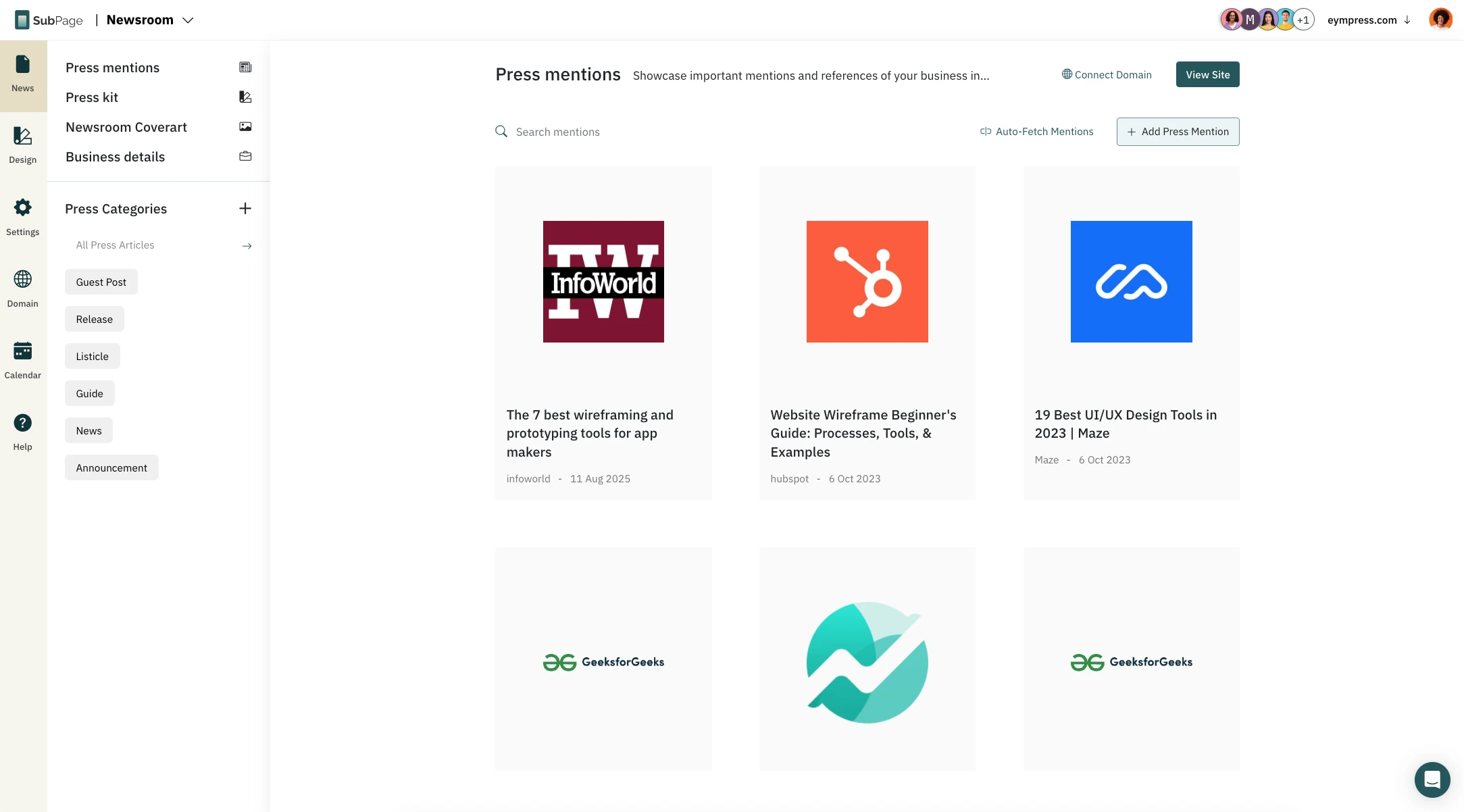
It also helps your PR team stay on top of coverage in real time. Rather than setting up a patchwork of Google Alerts and social monitoring tools, you have a single place where your press releases and your earned media sit together. That makes reporting easier, and it makes it faster to identify gaps in coverage or opportunities to follow up with journalists who have written about you before.
Auto-Fetch Press Mentions is available on SubPage's Growth plan, making it a practical addition for any team that is serious about managing their media presence — not just publishing into the void and hoping for pickup.
Conclusion
A press release is still one of the most effective tools a company has for reaching journalists and shaping how its news is covered. But its power depends entirely on how well it is written and where it lives.
AI is making it faster and easier for teams to produce high-quality releases consistently, but the fundamentals have not changed: lead with the news, write for the journalist, and make every word count. The companies that combine strong writing craft with smart tools will always have an edge.
If you are ready to give your press releases a proper home and a more efficient workflow, SubPage's newsroom builder lets you publish, organize, and manage all your press releases in one branded, press-ready page — with AI built in to help you create content faster. Get started for free today.
