Why AI Blog Writing Is Becoming Popular
Marketers have always been under pressure to publish more, rank higher, and convert faster — but the resources to do all three have rarely kept pace with demand. According to SEMrush, hybrid content — AI-assisted and human-edited — ranks 24% higher in search than content written entirely by humans.
The question is no longer whether AI belongs in a content workflow. It is why this shift is happening so quickly, what it means for businesses trying to grow through content, and how to use an AI blog writing tool in a way that actually produces results — not just output. SubPage is built precisely for this moment — a blogging tool that brings AI writing and SEO into a single publishing workflow. This post breaks it all down.
What is AI blog writing?
AI blog writing refers to the use of artificial intelligence tools to assist in — or, in some cases, fully generate — blog content. This includes drafting full posts from a prompt, rewriting existing sections, improving readability, optimizing headlines, and suggesting internal links or related topics based on your content strategy.
The key distinction worth making early: AI blog writing is not a single mode of operation. Some teams use AI to generate a first draft and then edit heavily. Others use it selectively — to rephrase a dense paragraph, expand a thin section, or generate a list of subheadings from an outline. The best outcomes tend to come from this hybrid approach.
What makes the current generation of AI blog writing tools different from earlier attempts is context. Modern tools understand tone, match writing style, follow instructions about the target audience, and produce content that can be refined rather than discarded.
Why AI blog writing is growing so fast
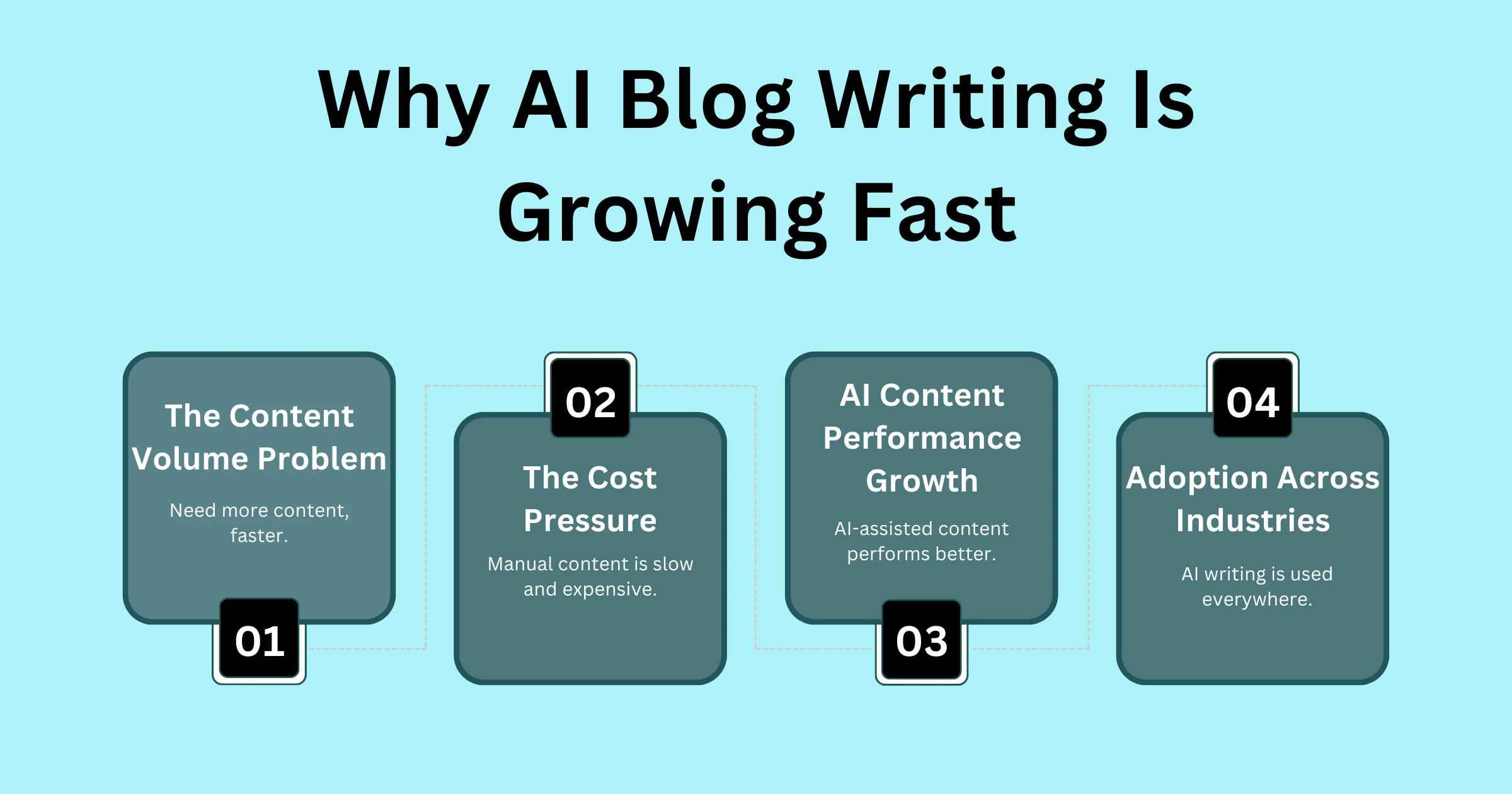
The content volume problem
One of the strongest drivers behind the rise of AI blog writing is simple: businesses need to produce more content than ever, and doing it manually does not scale. Blogging consistently remains one of the most effective ways to generate organic traffic — businesses that blog generate up to 67% more leads than those that do not. But consistent publishing requires consistent capacity, and most teams do not have it.
The cost pressure is real
Traditional content production — briefing a writer, waiting for a draft, editing, optimizing for SEO, publishing — is expensive and slow. For startups and growth-stage businesses operating with lean teams, this trade-off is hard to ignore.
AI content is maturing in search performance
Early concerns that AI blog writing would produce thin, low-ranking content have been largely overtaken by the data. Marketers using AI-generated content now report a 36% higher conversion rate on landing pages.
The nuance matters here: fully AI-generated content without human editing does underperform in trust and engagement metrics. But AI-assisted content — where a human shapes strategy, edits for accuracy, and adds genuine insight — performs competitively with, and sometimes better than, human-only writing.
Adoption is now across every industry
AI blog writing adoption is no longer limited to tech-forward companies. Small businesses are also catching up rapidly, driven by the availability of low-code, no-code AI platforms that require no technical expertise to operate.
According to HubSpot's 2025 AI Trends for Marketers report, blog posts and long-form content rank as the fourth most common AI use case for content teams — behind email, social media, and video. This signals that AI blog writing is now embedded in the standard content toolkit, not reserved for experimentation.
What AI blog writing tools actually do well
Understanding where an AI blog-writing tool adds the most value helps teams use it more strategically, rather than treating it as a replacement for thinking.
- Speed up the drafting phase. The blank page is one of the biggest productivity killers in content creation. AI tools eliminate it. Given a title, a keyword, and a brief outline, most modern AI blog writing tools produce a usable first draft in seconds — giving writers something to work with rather than starting from nothing.
- Improve structure and readability. AI tools are particularly strong at restructuring dense paragraphs, breaking up long sections, and suggesting more scannable formats. Given that 79% of readers scan blog posts before deciding whether to read in full, structure is not a cosmetic concern — it directly affects whether content converts.
- Support SEO at the post level. Many AI blog writing tools now include built-in SEO analysis — flagging keyword gaps, suggesting internal links, analyzing heading structure, and reviewing meta descriptions. This reduces the back-and-forth between writing and optimization that slows most content workflows.
- Repurpose and refresh existing content. Updating older posts is often faster and more effective than writing new ones. AI tools can take an existing post, identify what needs updating, and regenerate specific sections while maintaining the overall structure and tone — a task that would take a human writer significantly longer.
What AI blog writing tools do not replace
The data on hybrid content is clear: AI-assisted writing that includes genuine human insight outperforms fully automated output in search, engagement, and trust metrics. There are specific things an AI blog writing tool cannot replicate.
- Original research and first-hand expertise. AI generates content from patterns in existing data. It does not conduct interviews, run experiments, or produce genuinely new findings. Content that earns backlinks and builds topical authority usually contains something that cannot be found elsewhere — and that has to come from the human side of the process.
- Brand voice and strategic judgment. An AI tool can match a general tone, but the editorial decisions that make a blog actually serve business goals — which topics to prioritize, how to position a product, what angle will resonate with a specific audience — require human strategy behind them. If you are still working out that foundation, we have covered how to build a blog content strategy for SaaS startups in detail — it is a good place to start before layering AI into your process.
- Trust signals. Edelman's 2025 research found that AI-generated articles receive 43% lower trust ratings when readers know the content was fully AI-produced. Human-edited, fact-checked, and strategically positioned content retains the credibility that converts readers into customers.
How to use an AI blog writing tool effectively
The teams seeing the best results from AI blog writing are not the ones generating the most content — they are the ones integrating AI into a structured content process.
- Start with strategy, not prompts. Before using any AI blog writing tool, know your target keyword, your reader's pain point, and what action you want them to take. AI amplifies the direction you give it. A well-structured brief produces a much better output than an open-ended prompt. Once you have the draft, structure is what determines whether it converts — we broke down exactly how to structure a blog post for maximum conversions if you want to go deeper on that side of things.
- Edit with the reader in mind. After AI generates a draft, review it the way a reader would — not just for accuracy, but for whether it actually answers the question they came with. Add examples, data points, or perspectives that only your team can provide. That layer of human judgment is what separates good content from forgettable content.
- Use AI for the right tasks. Drafting, rephrasing, expanding thin sections, generating meta descriptions, and suggesting internal links are all high-value uses of an AI blog writing tool. Strategic decisions about content direction, audience targeting, and brand positioning are better left to human judgment — with AI available to execute against those decisions.
- Pair writing with SEO analysis. Publishing well-written content that no one finds is a common trap. AI blog writing tools that include SEO analysis — checking keyword placement, heading structure, internal links, and meta information — reduce the gap between a great post and a well-ranked one. If you want to make sure the layout itself is working in your favour too, it is worth reading through blog layout best practices for business websites — the structural decisions there sit right alongside what AI helps you write.
Why SubPage is built for this shift
SubPage brings AI blog writing directly into the publishing workflow — without requiring a separate stack of tools to manage the process.
The AI writing assistant inside SubPage's editor works inline. Select any section of text, click the AI icon, and choose from options including Rephrase, Make Shorter, Make Longer, or Write About This Text. Changes happen in context, not in a separate window. Undo is instant. The result is a writing experience where human judgment and AI assistance stay in the same place, rather than being split across multiple platforms.

- Beyond writing, SubPage includes a built-in SEO Report that reviews each post before it goes live — surfacing keyword gaps, internal link opportunities, and on-page improvements that directly affect rankings.
- Lead capture forms, newsletter subscriptions, and conversion analytics are part of the same platform. The entire journey from draft to published, optimized, converting blog post happens in one place.
- For teams building a blog from scratch or businesses ready to scale, SubPage removes the friction that usually slows the process down. Writing, SEO, and conversion are no longer three separate workflows — they happen together.
Conclusion
AI blog writing is not a shortcut for teams that do not want to put in the work. It is a tool that makes the work faster, more consistent, and more scalable — when it is used inside a strategy rather than as a substitute for one. The adoption data makes the trend clear: 97% of content marketers are moving in this direction. The teams that get ahead are the ones integrating AI with human judgment, strong structure, and a clear content strategy.
If you are ready to build a blog that publishes faster, ranks higher, and converts readers into customers, SubPage gives you the AI blog writing tool and the platform to do it — all in one place. Start writing smarter with SubPage — sign up free today.
