How Recruitment Management Software Improves Hiring Efficiency
According to Aptitude Research, recruiters spend around 26 hours every week on administrative tasks such as scheduling interviews and searching for candidates. For small businesses and SaaS teams, where hiring is often managed alongside other responsibilities, this manual work can quickly slow down the recruitment process and delay hiring decisions.
Recruitment management software helps solve these challenges by centralizing hiring activities, automating repetitive tasks, and giving teams better visibility into every stage of the recruitment process. While streamlining recruitment is essential, attracting the right candidates starts even earlier—with a professional careers page. Platforms like SubPage make it easy for growing businesses to build branded careers pages that showcase open roles and convert visitors into applicants. Together, a dedicated careers page and an efficient recruitment process help businesses hire faster and make better hiring decisions.
In this post, we'll explore how recruitment management software improves hiring efficiency for small businesses and SaaS teams, and why pairing it with the right careers page strategy leads to better hiring outcomes.
What recruitment management software actually does
Before getting into efficiency gains, it helps to be clear on what this software covers. A recruitment management system is a centralized platform that manages every stage of hiring — from posting a job listing and screening applicants to scheduling interviews and making offers.
At its core, it handles:
- Applicant tracking — organizing and scoring inbound applications automatically
- Resume parsing — extracting key candidate data without manual entry
- Candidate management — keeping all candidate communication, notes, and status in one place
- Recruiting automation — triggering follow-up emails, interview reminders, and stage updates without manual effort
For a small business owner wearing five hats or a SaaS HR manager managing two open roles per quarter, this isn't just convenience — it's a meaningful reduction in the administrative weight of hiring.
Why hiring efficiency is a bigger problem for smaller teams
Large enterprises have dedicated recruiting teams, sourcing specialists, and coordinators. When a small business or a lean SaaS company opens a role, one or two people handle everything: writing the job description, posting it, screening responses, scheduling interviews, coordinating with the hiring manager, and sending offers.
When that process is disorganized, it doesn't just slow things down — it creates real business risk. A role left open too long puts pressure on existing employees. A poor candidate experience sends applicants to competitors. A bad hire from a rushed process costs even more to fix.
The hiring process, when managed without a proper system, tends to break at the same points: applicant screening takes too long, communication falls through the cracks, and internal alignment between the hiring manager and HR is patchy at best.
Recruitment management software solves this by replacing scattered manual steps with a defined, repeatable workflow — one that doesn't require a full HR team to execute.
6 specific ways recruitment management software improves hiring efficiency
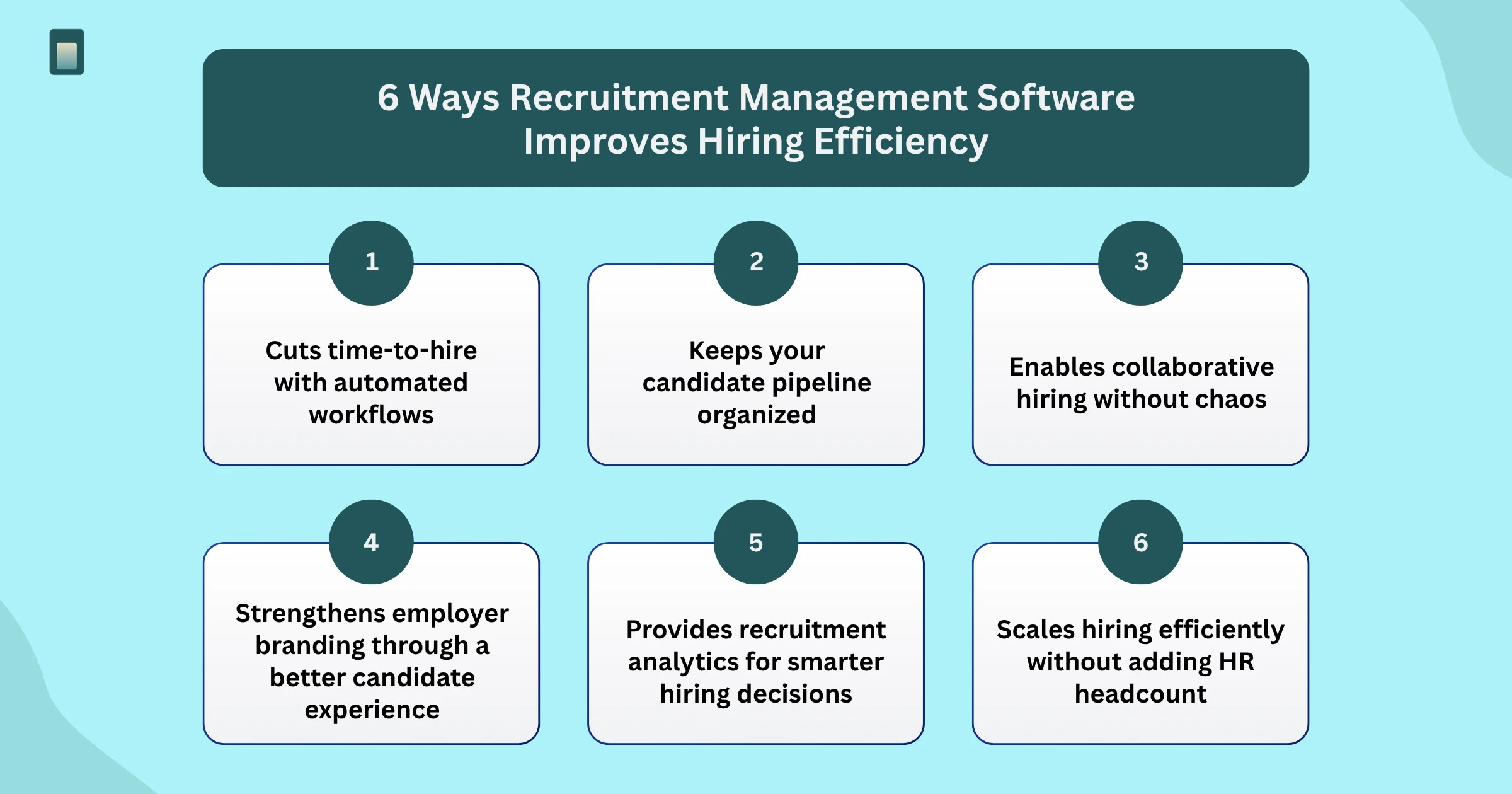
1. It cuts time-to-hire with automated workflows
One of the clearest benefits of recruitment process automation is the reduction in time-to-hire. Automated screening filters applications by required criteria before a human ever sees them. Interview slots can be shared directly with candidates for self-scheduling. Offer letters can be generated from templates in minutes.
For a SaaS company hiring a product manager or a small business bringing on a senior sales rep, shaving even a week off the hiring timeline can be the difference between landing your first choice and losing them to a faster competitor.
2. It keeps your candidate pipeline organized
A candidate pipeline that lives in your inbox is not a pipeline — it's a liability. Recruitment software gives you a visual, structured view of every candidate at every stage. You can see at a glance who needs a follow-up, who is waiting on an offer, and who has gone cold.
This is especially important for internal hiring. When you are considering existing employees for a new role — a common move for small businesses looking to retain talent and reduce onboarding costs — visibility into the process matters even more. Our guide on internal recruitment covers how to approach this structure effectively.
3. It enables collaborative hiring without chaos
Collaborative hiring — where multiple team members weigh in on a candidate — is increasingly common, especially in SaaS companies where cultural and functional fit both matter. But without a shared system, collaborative hiring creates its own problems: duplicate feedback, conflicting opinions with no documentation, and decisions made on gut feel rather than data.
Recruitment software gives every stakeholder a single place to leave structured feedback, view interview notes, and track where each candidate stands. The result is faster, better-aligned decisions — without the back-and-forth over email.
4. It protects your employer brand through a better candidate experience
Candidates talk. A slow response, a confusing application process, or complete silence after an interview all leave impressions that affect your ability to hire in the future. For small businesses, where every hire matters and reputation spreads fast in niche talent pools, this risk is amplified.
Recruitment software ensures consistent, timely communication at every stage. Automated status updates, interview confirmations, and rejection emails (yes, even those matter) create an experience that signals professionalism — which directly supports your employer branding.
If you want to understand how candidate experience specifically ties to your hiring outcomes, our post on what candidate experience means for small businesses goes deeper on this connection. And if you are actively building your employer presence, read how employer branding helps startups attract top talent.
5. It gives you data to make smarter decisions
Most small teams hire reactively — a role opens, they scramble to fill it, and then move on. There is rarely a structured review of what worked and what did not. Over time, this means repeating the same inefficiencies without ever diagnosing them.
HR recruitment software captures data across every hire: where your best candidates came from, which stage of the process has the highest drop-off, and how long each role takes to fill. This is the foundation of a real recruitment strategy — one built on evidence, not intuition.
For context on why this matters specifically for leaner teams, our article on why recruitment analytics matters for startups is worth a read.
6. It scales with your hiring needs — without adding headcount
One common misconception among small businesses is that recruitment software is only worth it if you are hiring constantly. The opposite is true. When you hire infrequently, the cost of inefficiency per hire is actually higher — because there is no routine to fall back on, and every role feels like starting from scratch.
A good recruitment management system gives you a reusable framework: saved job description templates, standardized screening questions, and a documented hiring workflow that your team can pick up and run whether you hire once a year or ten times.
Internal hiring: a use case that is often underserved
Many recruitment tools are built with external hiring in mind — sourcing from job boards, screening large applicant pools, managing agency relationships. But for small businesses and SaaS companies, some of the most impactful hires happen internally.
Promoting from within requires a different kind of process: transparent communication with internal candidates, careful management of expectations, and a structure that treats internal applicants with the same rigor as external ones — without the awkwardness that comes from informal, undocumented decisions.
Recruitment software supports this by giving HR teams a formal process for internal roles — one that is visible, fair, and documented. Combine this with a well-maintained candidate pipeline, and you have the foundation for a talent acquisition system that works in both directions.
For a comprehensive look at how a dedicated hiring platform elevates the overall experience, see how a talent acquisition system improves candidate experience.
Where your careers page fits into all of this
Recruitment software manages what happens after a candidate applies. But getting candidates to apply in the first place depends on how your hiring opportunity is presented to the world.
A dedicated career page — not just a LinkedIn post or a buried "jobs" link on your website — is the single most effective owned channel for attracting candidates who are already aligned with your company. It lets you control the narrative: your culture, your team, your values, your open roles.
SubPage makes it straightforward to build a careers page that reflects your brand and converts visitors into applicants. When paired with a recruitment management system that handles what happens next, you close the loop between attracting candidates and efficiently moving them through your process.
To understand why owned career pages outperform third-party job listings as a long-term channel, our comparison of careers page vs LinkedIn job posts explains the strategic difference clearly.
Conclusion
Hiring fewer people does not mean hiring with less care — it means every hire matters more. Recruitment management software gives small businesses and SaaS teams the structure, speed, and data they need to make each hire count — without the overhead of a full recruiting operation.
But efficient hiring starts before candidates enter your recruitment process. A professional careers page helps attract the right talent and creates a strong first impression of your company. With SubPage, you can build and manage a branded careers page that complements your recruitment workflow and helps convert visitors into applicants.
From organizing your candidate pipeline and automating your hiring workflow to supporting internal promotions and protecting your employer brand, the right system turns hiring from a reactive scramble into a repeatable, efficient process. And when that system is backed by a professional careers page that attracts the right candidates from the start, the entire recruitment cycle gets sharper.
Ready to build the hiring infrastructure your team deserves? Start with a careers page that works — and connect it to a process that converts. Sign up for SubPage free today and launch your careers page in minutes.
