How Hiring Pipelines Improve Candidate Experience
Job seekers don't just judge whether they got the role — they judge how they were treated while waiting to find out. SHRM's candidate experience research found that 36% of U.S. candidates hadn't heard back from an employer one to two months after applying, and that the highest-rated companies stood out specifically by moving candidates forward within three to five days. That silence is almost always a symptom of one thing: no defined hiring pipeline. When an application isn't tied to a clear stage, no one on the hiring team actually owns the job of following up.
A structured hiring pipeline fixes this by giving every applicant a visible place in the process, from application to offer, and giving your team a system to act on it. Paired with a clean, branded front door like the ones built with SubPage, a well-built pipeline is what turns a chaotic hiring process into one candidates actually trust.
What is a hiring pipeline?
A hiring pipeline is the sequence of stages a candidate moves through from the moment they apply to the moment they're hired. Most pipelines follow a similar shape: applied, screened, interviewed, offered, hired, with rejections branching off at any point along the way. The pipeline isn't the tool itself; it's the structural backbone of your recruitment process, the map that tells everyone, candidates and recruiters alike, where things stand.

This is different from a recruitment process in the abstract. A process describes what your team does. A pipeline describes where each candidate is inside that process at any given moment. Without that structure, a recruitment process exists only in people's heads and inboxes, which is exactly where candidates get lost.
Most teams manage this structure through a talent acquisition system, software that organizes candidates by stage instead of by scattered spreadsheet rows or email threads. Even simple pipelines benefit from this: a five-person startup hiring for two roles still needs to know, at a glance, who's waiting on a first response and who's already three interviews deep. If you want a deeper breakdown of how these systems work end to end, from sourcing through onboarding, see our full guide on talent acquisition systems.
It's worth noting that a pipeline can exist without dedicated software, at least in theory. A whiteboard or a shared spreadsheet technically tracks stages too. In practice, that approach rarely survives beyond a handful of open roles, because updating it depends on someone remembering to do so manually every time a candidate moves. The pipeline concept holds regardless of the tool; what changes is how reliably it gets maintained.
Why candidate experience depends on pipeline structure
Candidate experience isn't really about being polite. It's about visibility and predictability. The same SHRM research found that the longer the gap between applying and hearing back, the less likely candidates are to reapply or refer others in the future. Anything that leaves candidates guessing, even briefly, chips away at how they view your company.
That disengagement almost always traces back to pipeline gaps. Candidates don't leave because a hiring process is slow in the abstract; they leave because they don't know what stage they're in, when they'll hear back, or whether anyone is still looking at their application. A defined pipeline closes that gap by making progress visible instead of assumed.
This matters even more for candidates who are actively interviewing elsewhere. A candidate weighing two offers doesn't wait indefinitely for a company that seems disorganized; they follow the process that feels more certain. In that sense, a well-structured pipeline isn't just a courtesy; it's a competitive factor in whether your best candidates stay in your process at all. We've covered other common ways candidate experience breaks down in Candidate Experience: 5 Mistakes That Cost Your Applicants, several of which trace back to the same root cause: no clear stage ownership.
How a hiring pipeline improves candidate experience
Candidates always know where they stand
When stages are clearly defined, a recruiter can tell an applicant exactly where they are: in screening, in final interviews, or awaiting a decision, rather than a vague "we'll circle back." That single change addresses one of the most consistent complaints in candidate communication research: not the outcome, but the silence beforehand.
Fewer candidates fall through the cracks
Without a pipeline, follow-up depends on memory and inbox habits. With one, ownership is tied to the stage itself, so no candidate sits untouched because a recruiter assumed someone else was handling it. This is the core of good candidate management: nothing depends on a single person remembering a single email.
Faster movement between stages
A visible pipeline exposes bottlenecks that would otherwise go unnoticed, like a stage where candidates consistently sit for ten days before anyone reviews their file. Once that bottleneck is visible, it can be fixed, instead of only being discovered after good candidates have already accepted another offer. This is where a defined hiring workflow directly protects time-to-hire.
Consistent treatment across every applicant
Without structure, treatment depends entirely on which recruiter happens to pick up a file. One candidate gets a same-day response; another waits two weeks for no clear reason. A defined pipeline standardizes what happens and when for every applicant, which reduces both inconsistency and the risk of unconscious bias creeping into who gets prioritized.
Better handoffs between recruiters and hiring managers
Pipeline stages create natural checkpoints for feedback and decisions. A candidate moving from interview to offer stage should trigger a specific action from a specific person, not sit in limbo while an internal handoff quietly stalls. This is one of the most common places a recruitment process breaks down internally, even when the candidate-facing communication looks fine on the surface.
Clear visibility into where candidates drop off
A structured pipeline turns candidate drop-off from a mystery into a measurable, stage-by-stage problem. Instead of guessing why applications are down, teams can see exactly which stage loses the most candidates, whether that's a confusing application form or a stalled interview stage, and fix that specific step rather than overhauling the entire recruitment workflow.
Room for personalized touchpoints without extra manual work
Once candidates are organized by stage, personalizing communication becomes far easier, because a recruiter can message everyone at a given step at once instead of writing individual updates from scratch. A senior candidate three interviews in and a new applicant in initial screening don't need the same note, and a defined pipeline makes it simple to tell them apart without extra manual tracking.
Hiring pipeline vs. unstructured hiring process
Ad hoc hiring, spreadsheets, scattered email threads, and no defined stages can work when a company is filling one role a year. It breaks down quickly once volume grows. Communication becomes inconsistent, feedback gets lost between whoever is involved, and candidates experience the process differently depending on who happens to be handling their application.
A hiring pipeline replaces that inconsistency with a shared structure everyone can see. We've covered the tooling side of this comparison in more depth in Manual Hiring vs Recruitment Management System. Here, the point is simpler: even before software enters the picture, defining your stages is what determines whether candidates experience a process or a black hole. Teams without that structure tend to see the effects show up in the numbers, with average time-to-hire climbing well past a month industry-wide as unclear stages slow decisions down.
Best practices for managing a candidate pipeline
Building a pipeline that actually improves candidate experience comes down to a few consistent habits:
- Define your stages before you define your tools. Map the pipeline first, then choose software that fits it, not the other way around.
- Assign clear ownership for every stage, not just the final hiring decision.
- Set a maximum time-in-stage and flag any candidate who exceeds it for review.
- Communicate at every stage change, not only at application and rejection.
- Review stage-by-stage drop-off data on a regular basis to catch friction points early.
- Keep the pipeline visible to the entire hiring team, not just recruiting, so handoffs don't stall.
These practices are what separate a pipeline that exists on paper from one that candidates actually feel the benefit of.
How SubPage helps you build an efficient hiring pipeline
Pipeline structure has to start somewhere, and for most candidates that starting point is your careers page. SubPage gives you a professional, branded careers page that sets the tone before a candidate ever enters your pipeline, so the first impression matches the structure behind it.
From there, SubPage's built-in applicant tracking lets you manage candidates stage by stage without falling back on spreadsheets or scattered inboxes. Every applicant has a visible place in the pipeline, and every stage change is trackable rather than assumed.
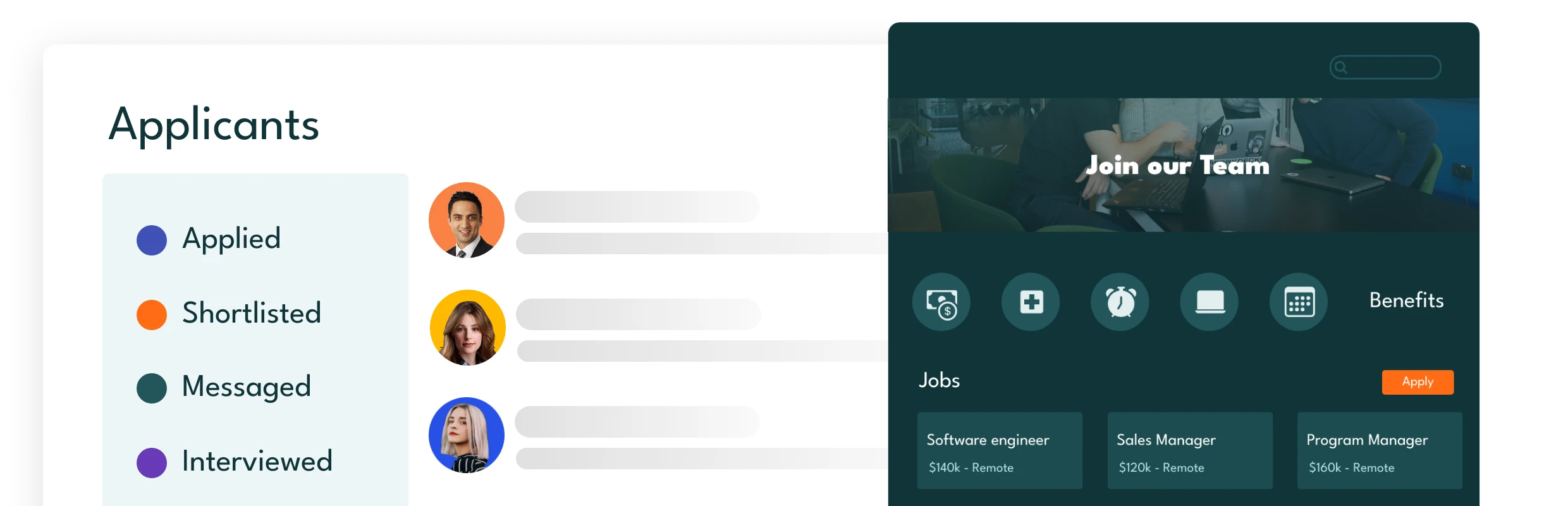
Collaborative hiring tools mean recruiters and hiring managers share the same view of where each candidate stands, which closes the internal handoff gaps that quietly stall pipelines. And because communication is tied directly to stage changes, candidates get timely updates without your team having to track who needs to hear what and when manually.
Try SubPage today and build a hiring pipeline candidates can actually trust.
Conclusion
A hiring pipeline isn't just an internal org chart for recruiters. It's the structure that determines whether candidates feel informed or ignored throughout your recruitment process. Clear stages, defined ownership, and visible progress turn an unpredictable hiring process into one that respects the people going through it, and that respect is what shapes whether top candidates stay engaged long enough to accept your offer.
SubPage helps you put that structure in place with a professional careers page, integrated applicant tracking, and communication tools that keep every candidate moving through your pipeline without falling silent.
Sign up for SubPage today and build a hiring pipeline that improves candidate experience from the very first application.