Candidate Experience: 5 Mistakes That Cost Your Applicants

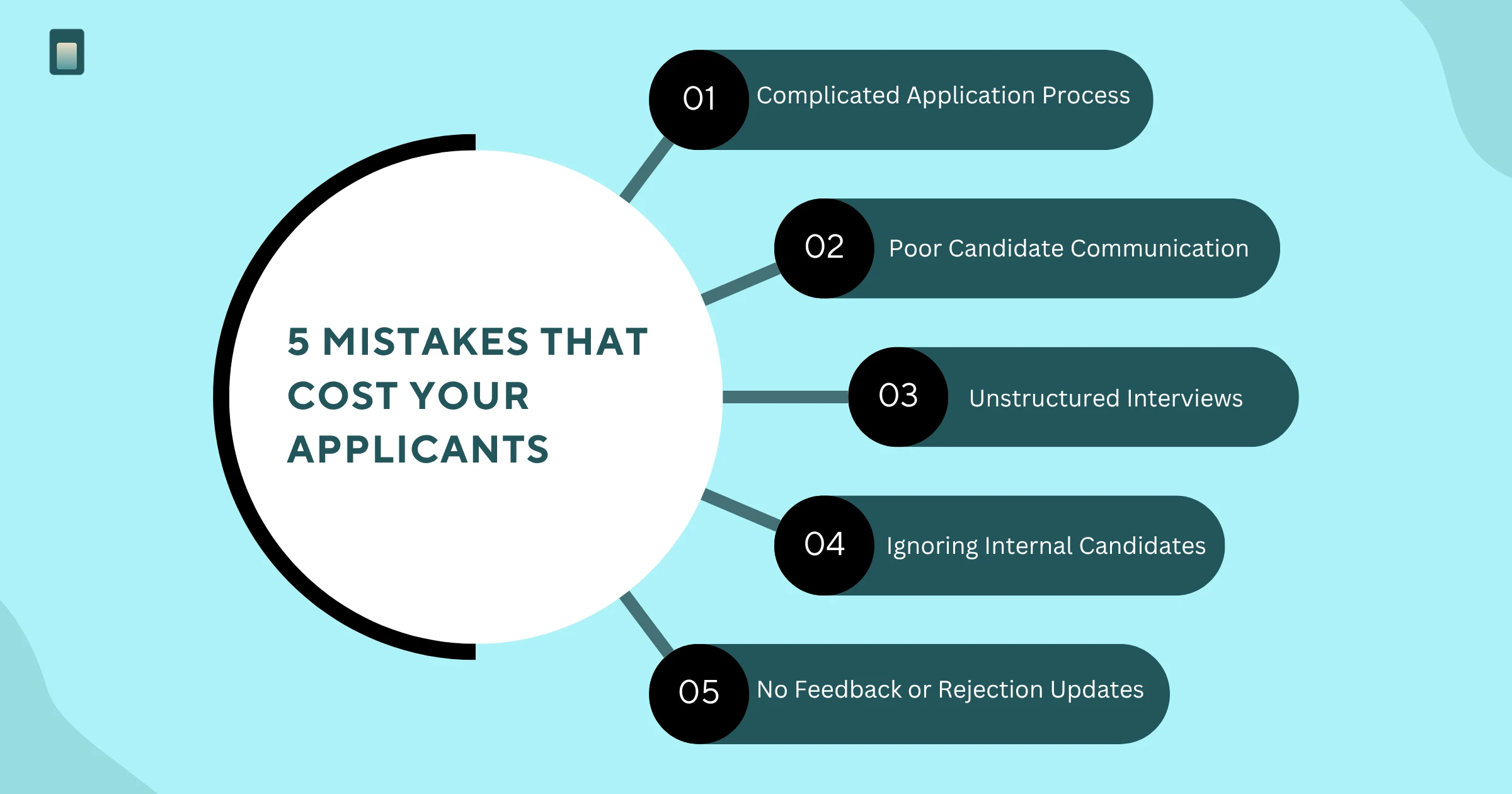
A confusing or lengthy application process that kills early interest
The most common candidate experience mistake happens before you ever see a resume: the application itself. Long forms, mandatory account creation, resume re-entry after you've already attached a resume, and vague or duplicate questions all push candidates to close the tab. Research on job application behavior consistently shows that applications requiring too much personal information or taking too long are among the top reasons for candidate drop-off, and the effect compounds with every extra field.
This is especially costly for SaaS and small teams competing for the same small pool of specialized talent. If a competitor's application takes three minutes and yours takes fifteen, you've lost strong candidates before your hiring manager ever reviews an application.
Fix it: Strip your application down to what you'll actually use in a first-round decision — resume, a short set of screening questions, contact details. Everything else can wait until later stages. A well-built careers page matters here because it's the container the whole application experience lives in — a fast, mobile-friendly apply flow built into the page itself removes most of this friction in one pass, instead of bolting a generic form onto a static "we're hiring" page.
It also helps to test your own application the way a candidate would. Sit down and fill it out yourself, on a phone, with a timer running. If it takes longer than five minutes for a role that doesn't genuinely require a portfolio or writing sample, that's a strong signal you're asking for more than you need at this stage. Save the deeper assessments — work samples, take-home exercises, detailed screening questionnaires — for candidates who've already cleared a first conversation, not the initial application.
Poor or no communication after the application is submitted
Silence is one of the fastest ways to damage the candidate journey. Once someone applies, they're anchoring their decisions — whether to keep interviewing elsewhere, whether to wait for you — around whatever signal your process gives them. No signal at all reads as disinterest, even if you're simply busy.
Small teams are especially prone to this mistake because there's often no dedicated recruiter managing communication full-time; updates fall through the cracks between a founder's other responsibilities. The impact isn't limited to the candidate who goes silent on you — poor communication during recruitment shapes how people talk about your company to their own network, which quietly damages employer branding over time.
Fix it: Set a communication cadence before you post the role — acknowledgment within 24-48 hours, a status update at each stage, and a firm decision date you actually hold to. This is really a tracking problem more than a discipline problem: an applicant tracking system tied to your careers page means every application already has a status, so a status update is a two-minute task instead of something someone has to remember to do from scratch.
Even when there's genuinely no update to share, a short "still reviewing, expect to hear more by [date]" note beats silence every time. Candidates aren't expecting instant decisions — most understand that hiring, especially at a small company, takes time. What erodes trust is the absence of any signal at all, which forces candidates to guess whether they're still being considered or should move on.
An unstructured or inconsistent interview process
When every candidate for the same role gets a different set of questions, asked in a different order, by interviewers working from no shared rubric, two things happen: your hiring decisions get less reliable, and candidates notice the inconsistency. A rushed, disorganized interview signals a rushed, disorganized company — and top candidates, who usually have other offers in motion, take that signal seriously.
This is one of the most fixable recruitment process mistakes to avoid, because it doesn't require new tools or budget — just a bit of planning before the first interview is scheduled. It's also one of the biggest single points of candidate drop-off in the entire hiring funnel, more than application abandonment or scheduling delays combined.
Fix it: Build a shared interview scorecard before you schedule anyone. Every candidate answers the same core questions, scored the same way, by a small, defined panel. This is a foundational part of any serious talent acquisition approach — not a bureaucratic add-on — and it improves both hiring accuracy and the applicant experience at the same time. No tool fixes this one directly; it's a planning discipline, and it's worth being honest that structure here comes from your team's process, not from software.
Structure also protects you from an interview process that quietly drags on. Set the number of rounds and interviewers before the process starts, and communicate that plan to candidates upfront. A candidate who knows they're in a three-stage process with a two-week timeline can plan around it; a candidate facing an open-ended series of "just one more conversation" requests starts to assume — often correctly — that the company itself is disorganized.
Ignoring the internal candidate experience
Internal candidates — people up for a promotion, a transfer, or a lateral move — are easy to overlook because they're "already ours." But an internal hiring process that skips the structure you'd apply to an external candidate (clear criteria, real interviews, actual feedback) sends a damaging message: internal opportunities aren't taken seriously, and advancement is more about politics than merit.
This mistake is especially common in small businesses and SaaS teams, where internal moves often happen informally over a conversation rather than through a defined process. The candidate experience during an internal move matters just as much as it does externally — arguably more, since the person evaluating your fairness is someone who already works for you and will keep talking to your team regardless of the outcome.
Fix it: Apply the same structured process — clear role criteria, a real interview or evaluation conversation, explicit feedback — to internal moves that you'd apply to an external hire. Posting internal openings on the same talent acquisition system and careers infrastructure you use externally, rather than handling them over a private conversation, is a simple way to force the same consistency onto both paths.
It's also worth being explicit with internal candidates about why a decision was made, even when the answer is simply "someone else was a stronger fit right now." Employees who understand the reasoning behind an internal hiring decision — even one that doesn't go their way — are far more likely to stay engaged than those left to speculate. Silence in an internal process reads the same way ghosting does externally: as a lack of respect for the time someone invested.
Failing to close the loop — no feedback, no rejection notice, ghosting candidates
The final and most damaging mistake is also the easiest to fix: never telling a candidate where they stand. Most candidates want to know as soon as they're no longer being considered, and most also want a clear reason why — yet the overwhelming majority of rejected candidates receive no feedback at all. That gap between what candidates want and what most companies deliver is where a lot of quiet brand damage happens.
Ghosting doesn't just hurt the candidate in front of you. Candidates talk, especially within tight-knit professional networks and specific industries — the kind small businesses and SaaS companies often recruit from repeatedly. A reputation for silence follows you into your next hiring cycle, making an already competitive market harder.
Fix it: Build closing the loop into your process as a required last step, not an optional courtesy — a short templated rejection email, sent within a set number of days, is far better than nothing. For teams juggling recruitment process management alongside everything else, purpose-built recruitment software can automate this final stage — triggering a templated close-out message the moment a candidate's status changes — so it never depends on someone remembering to do it manually during a busy week.
A short, genuine note also creates future upside. Candidates who receive even brief feedback are far more likely to reapply for a different role down the line, or to refer someone else in their network — and a graceful rejection often does more for your employer brand than a mediocre hire would have. Treating "no" as a normal, respectful part of the process — rather than an outcome to avoid communicating — turns a moment of potential brand damage into one that reflects well on your company.
Bringing it together
None of these five mistakes require a big budget to fix — just attention to a process that's often running on autopilot. A shorter application, consistent communication, structured interviews, a fair internal process, and a real close to every candidate's journey compound into a hiring process that keeps strong candidates instead of quietly losing them.
Ready to fix your hiring process? Start for free on SubPage →