30 Jun 2026
Manual Hiring vs Recruitment Management System
Small and mid-sized companies are losing the hiring race against a process that simply takes too long. In 2025, the average time from job posting to accepted offer reached 63.5 days, and 90% of companies failed to meet their hiring targets. For a small business filling even one or two internal roles, that's months of lost productivity — and often a top candidate accepting an offer elsewhere before a decision gets made.
This is the core tension behind manual hiring vs. recruitment management systems. Small businesses and SaaS companies with modest, internal hiring needs often default to spreadsheets, inboxes, and informal processes simply because they're familiar. It works — until hiring volume grows, more people get involved, or roles need to move faster than the process allows.
Before comparing tools, it helps to get the foundation right. A structured careers page, like the ones built with SubPage, gives candidates a single, professional entry point regardless of whether you're hiring manually or through software. From there, the real question is whether to stay manual or move to a recruitment management system (RMS) — and where SubPage fits into that decision.
What is manual hiring?
Manual hiring is the practice of managing the recruitment process using general-purpose tools instead of dedicated recruitment software. For most small businesses, this looks like spreadsheets to track candidates and interview stages, email threads for scheduling and follow-ups, shared documents for interview feedback, job postings managed individually across multiple job boards, and informal handoffs between hiring managers and founders.
Manual hiring isn't inherently wrong.

For a company hiring one role a year, it can be perfectly manageable. The problems tend to show up when hiring volume increases even slightly, multiple people get involved in decision-making, or roles need to move faster than the process allows.
What is a recruitment management system?
A recruitment management system is software built specifically to manage the recruitment process from job posting through offer and onboarding. It centralizes candidate data, automates repetitive hiring workflow steps, and gives every stakeholder — hiring managers, founders, and HR — visibility into where each candidate stands.
At its core, a recruitment management system typically includes a centralized candidate database and pipeline view, structured stages for each step of the hiring workflow, built-in scheduling and communication tools, collaboration features for interview feedback and scoring, and reporting on time-to-hire, source effectiveness, and pipeline health.
Unlike a generic applicant tracking system used purely for storing resumes, a recruitment management system is designed to manage the full recruitment process end to end, which makes it especially useful for small teams that don't have a dedicated recruiter coordinating everything manually. This is the layer SubPage is built to plug into — starting with the careers page candidates see first, and connecting forward into whatever structured workflow sits behind it.
Manual hiring vs recruitment management system: key differences
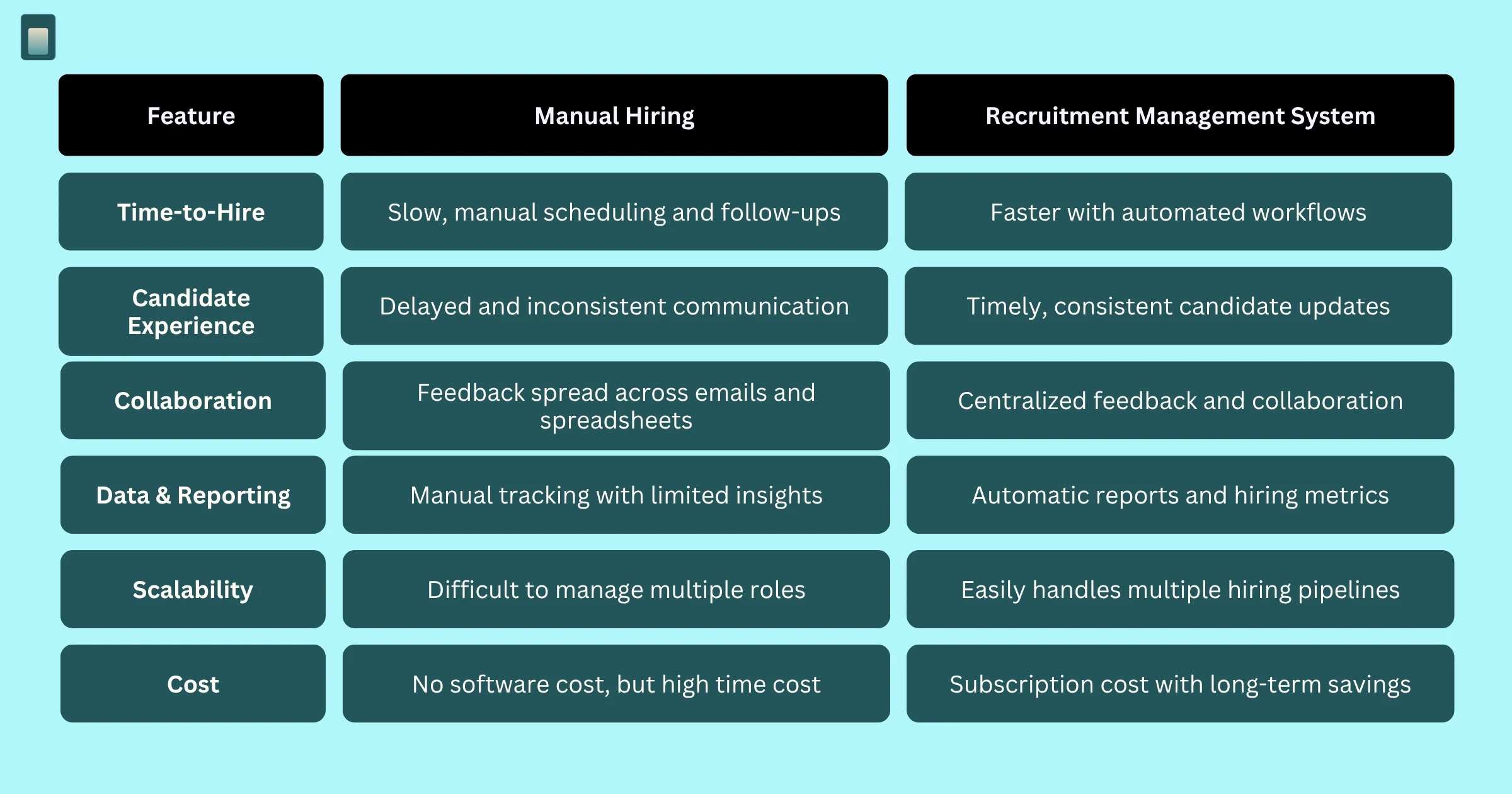
The clearest way to evaluate manual hiring vs recruitment management system options is to look at how each performs across the parts of hiring that matter most to a small business.
Time-to-hire
Manual processes rely on people remembering to follow up, manually scheduling interviews, and chasing feedback over email. A recruitment management system automates these steps, which directly addresses why businesses should replace manual hiring once delays start costing them candidates.
Candidate experience
Candidates judge a company by how organized its hiring process feels, and manual hiring tends to produce delayed responses and inconsistent communication. This is a deep topic on its own — see our guide on what candidate experience is and how your careers page impacts it for a full breakdown.
Collaboration across hiring managers
When more than one person is involved in hiring — common in small businesses where founders, team leads, and HR all weigh in — manual processes create version-control chaos across spreadsheets and inboxes. A recruitment management system gives everyone the same real-time view of every candidate.
Data and reporting
Spreadsheets can hold data, but they don't generate insight without manual effort. Recruitment management software automatically tracks metrics like time-to-hire and source performance, making it easier to spot where the recruitment process is breaking down.
Scalability
A manual process that works for one open role rarely scales cleanly to three or four simultaneous roles. Recruitment automation is built to handle multiple pipelines at once without the coordination overhead growing in proportion — and a SubPage careers page scales with that growth from day one, holding up just as well at several open roles as it does at one.
Cost
Manual hiring appears free because there's no software subscription, but the hidden cost is time — hours spent on scheduling, follow-ups, and status updates that could go toward actual team-building work. For a founder or office manager juggling hiring alongside their primary role, this time is rarely tracked, which makes manual hiring look cheaper on paper than it actually is. For small businesses hiring more than two or three roles a year, the value of hours saved usually outweighs the subscription cost of recruitment management software.
Challenges of manual recruitment processes
Manual recruitment process challenges tend to compound rather than stay isolated: lost or duplicated candidate information, inconsistent interview processes, slow follow-ups that cause strong candidates to accept other offers, no visibility into where candidates stall, and heavy reliance on one person — often a founder or office manager — to hold the entire process together.
For a small business hiring within the company — filling internal roles rather than running constant external recruiting — these challenges are magnified because there's rarely a dedicated recruiter to absorb the administrative load. SubPage addresses the first and most visible piece of this: a structured, branded careers page that replaces the scattered job postings and missing front door that make a manual recruitment process feel disorganized from the outside. If you're earlier in the process of deciding what to prioritize, this guide on choosing a recruitment management system: what every company should know walks through the evaluation criteria in more depth.
Benefits of recruitment management systems over manual hiring
The benefits of recruitment management systems over manual hiring become most visible for companies that hire a small but steady number of roles each year.
- Faster decision-making, since interview feedback and candidate status are visible in one place instead of scattered across emails
- Reduced administrative burden on whoever currently owns hiring, freeing them up for higher-value work
- Clearer accountability, since every hiring manager can see their responsibilities within the workflow
- Lower risk of a bad hire, since structured scorecards and shared feedback reduce decisions made on gut feel alone
For SaaS companies in particular, where hiring is often handled by a small internal team without a dedicated HR function, a recruitment management system replaces the informal coordination that otherwise depends on a few people remembering everything correctly.
How recruitment management software simplifies hiring
Recruitment management software simplifies hiring by replacing manual coordination with automation and structure, so people spend their time evaluating candidates instead of chasing updates and scheduling interviews. For the small business decision at hand, what matters most is this: recruitment automation reduces the chance that a strong candidate falls through the cracks simply because no one on a small internal team followed up in time.
Recruitment software for small businesses: what to look for
Not every recruitment management system is built with small businesses or lean SaaS teams in mind. When evaluating recruitment software for small businesses, prioritize simplicity over complexity, easy collaboration for non-recruiters, clear ownership controls so it's obvious who's responsible for moving each candidate forward, transparent pricing that scales with hiring volume, quick setup, and integration with your existing careers page so applications flow directly into the system without manual re-entry.
The goal isn't to find the most feature-dense talent acquisition software on the market — it's to find a system that removes the friction your current manual recruitment process is creating, without adding new complexity in its place.
Where SubPage fits into this decision
For small businesses and SaaS companies weighing manual hiring vs recruitment management system options, the starting point doesn't have to be a complex platform migration. SubPage is built around the part of hiring that small teams consistently underinvest in: the careers page that sits at the very front of the recruitment workflow.
Here's where SubPage fits into the decision:
- Replaces scattered job listings — instead of posting roles across multiple job boards and social channels, every opening lives in one structured, branded location
- Built for lean teams, not enterprise HR departments — setup doesn't require a dedicated recruiter or a long implementation cycle, which matters for small businesses and SaaS teams hiring internally
- Scales alongside hiring volume — a SubPage careers page holds up just as well at three or four open roles as it does at one, so you're not forced to switch tools as you grow
- Strengthens candidate experience from the first click — a branded, fast-loading careers page sets expectations before a candidate ever applies; see our guide on what candidate experience is and how your careers page impacts it for the full picture
- Connects rather than replaces — SubPage is the front door that feeds directly into whatever recruitment workflow sits behind it, whether that's a manual process today or a full recruitment management system later
- Gives you a head start on evaluation — if you're still comparing platforms, our guide on choosing a recruitment management system: what every company should know covers the criteria worth prioritizing before you commit
Starting with a structured careers page through SubPage is the lowest-friction first step for a small business still deciding between staying manual and adopting a full recruitment management system. It replaces the most visible symptom of a manual recruitment process — a disorganized or missing careers presence — while leaving room to add deeper recruitment automation as hiring volume grows.
Conclusion
The manual recruitment vs automated recruitment decision comes down to how much hidden time and risk your current process is absorbing. Manual hiring can work for very low, infrequent hiring needs, but for small businesses and SaaS companies hiring consistently — even at modest volume — a recruitment management system removes the coordination burden and creates a far better experience for candidates and hiring managers alike.
If your team is spending more time managing the hiring process than evaluating candidates, that's a clear sign to move beyond spreadsheets and email threads. Starting with a structured, branded careers page is the simplest first move toward a real recruitment management system — and it's exactly what SubPage is built to help you do.
Ready to build a stronger hiring process? Get started for free with SubPage and create a careers page that's ready to plug into a structured recruitment workflow from day one.
Share: