19 Aug 2026
Candidate sourcing strategies for growing companies
Finding good people is no longer as simple as posting a job and waiting. According to LinkedIn's Future of Recruiting research, roughly 70% of the global workforce is passive talent — professionals who aren't actively job hunting but would consider the right opportunity. For growing companies without a large recruiting team, that statistic changes everything about how hiring should work. You can't wait for great candidates to apply; you need a deliberate candidate sourcing strategy to find and engage them first.
This is where most growing companies get stuck. Hiring picks up faster than the systems needed to support it, and teams end up sourcing candidates reactively — one role, one job board, one scramble at a time. A tool like SubPage's careers page builder helps fix part of that problem by giving you a professional, centralized hiring presence in minutes, but sourcing also depends on the channels, habits, and processes your team builds around it.
In this guide, we'll break down what candidate sourcing actually means, why it matters more for growing companies than almost anyone else, and the candidate sourcing methods worth building into your recruitment process this year.
What is candidate sourcing?
Candidate sourcing is the proactive process of identifying, researching, and engaging potential candidates for open or upcoming roles, rather than waiting for applications to arrive. It sits at the very top of the recruitment process, before screening or interviewing even begins, and it covers both active job seekers and the much larger pool of passive candidates who aren't browsing job boards but might say yes to the right conversation.

Sourcing is often confused with recruiting or talent acquisition more broadly, but it's really one specific stage inside that process — the part focused on discovery and outreach. If you want the full picture of how sourcing fits alongside screening, interviewing, and onboarding, this talent acquisition system guide breaks down each stage, and the talent acquisition system glossary entry is a good quick reference for the terminology.
Why candidate sourcing strategies matter for growing companies
Growing companies face a particular version of the hiring problem. You're competing against larger companies with recognizable names and bigger budgets, but you're usually doing it with a founder, a generalist HR hire, or a two-person people team instead of a dedicated recruiting department. That gap is exactly why recruitment strategies for growing companies need to lean harder on sourcing rather than job-board posting alone.
A strong sourcing strategy gives you three advantages that reactive hiring can't:
- Access to the passive majority. Since most qualified professionals aren't actively applying anywhere, sourcing is often the only way to reach them at all.
- Shorter time-to-hire. Building relationships with candidates before a role opens means you're not starting the search from zero every time someone leaves or a new position is approved.
- Better-fit hires. Instead of choosing from whoever happened to apply, you can target people whose skills and experience actually match what the role needs.
Effective candidate sourcing isn't a one-off project — it's an ongoing habit that compounds. Every conversation, referral, and rediscovered resume adds to a pipeline you can draw from the next time you're hiring, which is a big part of how to build a strong candidate sourcing strategy that scales alongside your headcount.
Candidate sourcing strategies for growing companies
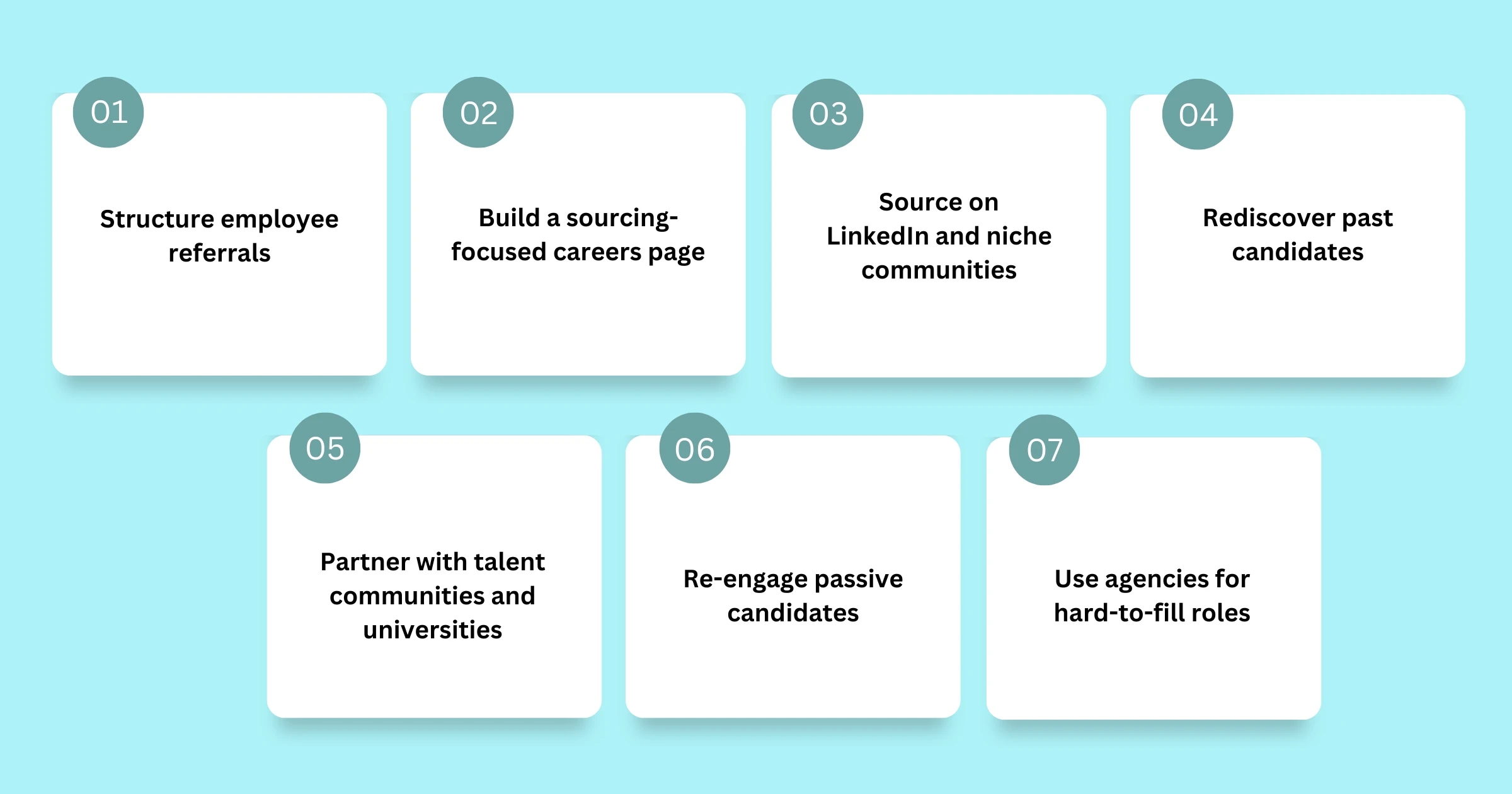
Here are the sourcing methods that consistently work well for small and mid-sized teams, without requiring an enterprise-level recruiting budget.
1. Turn employee referrals into a structured channel
Referred candidates tend to be a strong source of quality hires because your existing team already understands the role and the culture before they recommend someone. The mistake most growing companies make is treating referrals as a one-time announcement rather than an ongoing channel. Ask specifically — by role and by team — instead of sending a generic "know anyone?" message, and make sure employees know what's currently open. This turns your whole company into a sourcing channel and is one of the simplest recruitment strategies to keep running in the background.
2. Build a careers page that works as a sourcing engine
Your careers page isn't just a landing spot for people who already know about you — it's a sourcing asset in its own right when it's optimized to rank in search and convert visitors into applicants. Knowing how to create an effective careers page for recruitment means clear open roles, a fast mobile-friendly apply flow, and honest details about culture and benefits, not just a list of job titles. For a deeper look at layout and content decisions, this guide to careers page best practices covers what to prioritize when time is limited.
3. Source actively on LinkedIn and niche communities
LinkedIn remains the dominant channel for social recruiting, but effective candidate sourcing goes beyond keyword searches. Join and participate in niche communities relevant to your industry — Slack groups, subreddits, Discord servers, or professional associations — where the specific talent you need already gathers. This matters most for hard-to-fill or specialized roles that a general job board rarely surfaces well.
4. Rediscover candidates already in your pipeline
One of the most overlooked candidate sourcing methods is looking at people you've already talked to. Past applicants who weren't right for a previous role, or candidates who dropped out of a process at the wrong time, are often still a great fit for something new. An applicant tracking system makes this realistic by letting you tag, search, and filter historical candidates instead of digging through old email threads. This guide on how an applicant tracking system improves hiring explains how that rediscovery process works in practice.
5. Partner with talent communities, bootcamps, and universities
For growing companies hiring junior to mid-level talent, partnerships with coding bootcamps, university programs, and alumni networks create a steady, low-cost pipeline. These relationships take time to build but pay off well beyond a single hiring cycle, since the same programs keep producing new candidates every semester.
6. Re-engage passive candidates with targeted outreach
Passive candidates need a reason to consider a move, so generic outreach rarely works. Personalize messages around what's genuinely relevant to them — a specific project, a shared connection, or a problem your company is solving that matches their background. This is slower than posting a job, but it's often the only way growing companies can attract qualified candidates who aren't actively looking elsewhere.
7. Use recruitment agencies selectively for hard-to-fill roles
Agencies and recruiting partners aren't the right fit for every hire, but for specialized or senior roles where internal sourcing capacity is limited, they can extend your reach quickly. Treat this as a targeted tool for specific gaps rather than a default channel, since agency fees add up fast for a growing company's budget.
How SubPage supports candidate sourcing for growing companies
Sourcing works best when the destination you're sending candidates to is worth arriving at. SubPage gives growing companies a professional hiring presence without needing a developer or a big design budget, with an SEO-optimized careers page and a built-in Applicant Tracking system for tagging referrals, rediscovering past applicants, and keeping every sourced candidate organized in one place instead of scattered spreadsheets.
A consistent, well-organized hiring process also protects the sourcing work you've already done — candidates who have a poor experience after being sourced are unlikely to refer others. This breakdown of candidate experience mistakes covers where that experience most often breaks down.
Best practices to strengthen your candidate sourcing strategy
- Treat sourcing as continuous, not campaign-based. The strongest pipelines are built between hiring cycles, not scrambled together after a role opens.
- Track where your best hires actually come from. Source-of-hire data tells you which channels deserve more time and which aren't worth the effort.
- Keep your employer brand consistent everywhere candidates encounter it. Sourcing brings people to your company; a weak or inconsistent brand is what makes them leave before applying. This guide on how employer branding helps startups attract top talent covers the fundamentals.
- Personalize outreach at the message level, not just the channel level. A templated message to a passive candidate rarely converts as well as one referencing something specific about their background.
- Pair sourcing with the rest of your hiring process. Great sourcing loses its value if interviews are unstructured or slow — this guide to talent acquisition strategies for growing teams covers what happens after a candidate is sourced, from structured interviews to funnel tracking.
Conclusion
Effective candidate sourcing strategies for small businesses and growing companies alike come down to the same idea: stop waiting for candidates to find you, and build the channels, relationships, and systems that let you find them first. Referrals, a careers page built to convert, active outreach, and a well-organized ATS all work together to create a pipeline that holds up as your hiring needs grow.
You don't need a large recruiting team to start. You need a clear plan, the right channels for your industry, and a hiring presence that reflects the company you're building. Sign up for SubPage today and start building a careers page and sourcing workflow that helps your growing company attract the right candidates, faster.
Share:
