Careers Page Best Practices for SaaS Companies
Hiring in a SaaS company looks different from hiring at a 500-person enterprise. You are not running bulk recruitment drives or managing hundreds of applicants every week. You are making a small number of deliberate hires, and each one counts. Your careers page is often the first place a potential hire learns what your company is actually like — and that first impression shapes whether they apply at all.
According to LinkedIn Talent Solutions, 75% of candidates research a company's reputation and employer brand before applying for a job, and the careers page is typically their first stop. For small SaaS teams where one wrong hire or one missed opportunity to attract the right person can set the roadmap back by months, that page carries more weight than most founders and HR leads realize.
This guide breaks down careers page best practices specifically for SaaS companies that are hiring a small number of roles at a time and want to keep the door open for internal movement too. Whether you are building your careers page for the first time or tightening up what you already have, these practices will help you attract and convert the right candidates consistently.
Why your careers page matters more in SaaS
Most job seekers do not apply the moment they see a listing on a job board. They look up the company. They navigate to the website, find the careers section, and form a judgment within minutes. If that page looks outdated, vague, or generic, they close the tab and move on.
For SaaS companies, this is a bigger risk than it might seem. You are competing with better-funded companies for the same pool of product managers, engineers, growth marketers, and customer success leads. The companies that win those candidates are not always the ones with the most budget. They are the ones whose careers page communicates purpose, culture, and opportunity more clearly.

This is where your careers page stops being an afterthought and becomes an active part of your hiring process. A well-structured page reduces the effort a candidate has to put in, builds trust before a single conversation happens, and creates a clear path from discovery to application.
Understanding how your careers page fits into the broader candidate experience is equally important. Every touchpoint a candidate has with your company, starting from that first visit to your careers page, shapes their willingness to engage and move forward.
Core elements every SaaS careers page must have
Before getting into best practices, it helps to know what the foundation looks like. A careers page for a SaaS company serving small businesses or growing as one should include a few non-negotiables.
A clear headline that communicates who you are and what working there means. Avoid generic phrases like "join our team." Lead with something that reflects your company's mission or stage — candidates can spot filler from a distance.
A culture section that shows rather than tells. Instead of listing values, show how they play out. A quote from a team member, a photo from a team offsite, or a short paragraph about how decisions are made goes further than a bullet list of adjectives.
Open roles with enough detail to qualify and excite. Each job description should explain the role's scope, the current stage of the team or product, what success looks like in the first 90 days, and what the candidate can realistically expect in terms of growth.
A transparent overview of compensation and benefits. Candidates for SaaS roles, especially senior ones, factor in equity, flexibility, and trajectory. Being upfront signals respect for their time and positions your company as one that treats candidates as adults.
A simple, frictionless application process. Long forms and broken links lose candidates who were already interested. The path from "I want to apply" to "application submitted" should take under five minutes.
Careers page best practices for small SaaS hiring teams
When you are hiring for five roles a year rather than fifty, the way you build and manage your careers page changes. Here are the practices that matter most for leaner teams.
Keep the page focused on the roles you are actually hiring for. Nothing signals stagnation faster than a careers page full of positions that were filled six months ago. Keep listings current, and if there are no open roles right now, say so clearly while inviting candidates to stay connected.
Write role descriptions in the same voice your team uses internally. SaaS candidates are savvy. Overly corporate or templated language creates distance. If your team communicates directly and without jargon, your job posts should too.
Use your careers page to show what growth looks like. Small SaaS companies can struggle to compete with the perceived career trajectory of larger organizations. Address this directly. Explain how team members have grown, what ownership looks like at each stage, and where the company is headed. This reassures candidates who might otherwise assume a small team means a ceiling.
Make it mobile-first. A significant portion of job seekers browse and apply on their phones. A careers page that breaks on mobile or serves a clunky application experience loses candidates before they even finish reading the job post.
Add a lightweight FAQ. For small teams that cannot respond to every candidate inquiry in real time, a short FAQ on your careers page reduces friction and manages expectations proactively. Questions like "what does your interview process look like?" and "do you offer remote work?" are worth answering upfront.
If you are managing the end-to-end hiring process with limited resources, pairing your careers page with the right recruitment management system ensures that candidates who come through the page are tracked, communicated with, and moved through the pipeline without anything slipping through the cracks.
Designing your careers page for internal hiring, too
Small SaaS companies often overlook internal mobility as a hiring strategy. When a new role opens up, the default is to post externally and start from scratch. But promoting or transitioning someone already on the team is often faster, less expensive, and more likely to result in strong performance — because the person already understands your product, your culture, and your customers.
Your careers page can serve internal candidates just as effectively as external ones if it is designed with that in mind.
Include a line or a dedicated section on your careers page that explicitly invites internal applications. Something as straightforward as "We encourage team members to apply for any role they are interested in" sends a clear signal that growth is not just a talking point.
Make sure your internal job descriptions include the same level of detail as external-facing ones. Internal candidates deserve the same clarity about scope, expectations, and growth that you would offer someone discovering your company for the first time.
Consider pairing your careers page with an internal channel where new roles are shared first. Even if a role eventually goes external, giving your team first visibility builds trust and reinforces a culture where people see a future inside the company.
This approach also helps your hiring process stay consistent. When you use the same structured page and the same process for both internal and external candidates, evaluation becomes more objective and less likely to be influenced by familiarity.
If your team is growing and you want hiring coordination between managers and hiring leads to stay organized, learning how recruitment software helps HR teams collaborate better is worth exploring alongside this guide.
Common careers page mistakes SaaS companies make
Even companies that invest heavily in their product and brand often let the careers page slide. These are the most common mistakes that are worth fixing before they cost you a strong candidate.
Treating the careers page as a one-time setup. The best careers pages are updated regularly. New team photos, a recently revised culture statement, or a fresh set of open roles can be the difference between a page that converts and one that quietly puts candidates off.
Listing roles without context. A title and a list of requirements are not a job description. Candidates want to know the story behind the role, what problem it solves, who they will work with, and what growth looks like in practice.
Making the application process longer than it needs to be. Lengthy forms with redundant questions create drop-off. Especially for senior candidates who are not actively searching, friction in the application process is enough reason to walk away.
Forgetting to optimize for search. If your careers page is not indexed properly or your role titles do not match what candidates are actually searching, you are limiting your own reach without realizing it. Clear page structure, descriptive role titles, and basic SEO hygiene all help your page appear when it should.
Ignoring the page when hiring slows down. Many teams only update their careers page when they have urgent roles to fill, which means it is always behind. Keeping it maintained even during quieter periods means it is ready to perform the moment you need it.
How SubPage helps you build a careers page that converts
SubPage is built for exactly this use case — SaaS companies and small businesses that need a professional, conversion-ready careers page without the overhead of a developer or a bloated enterprise HR platform.
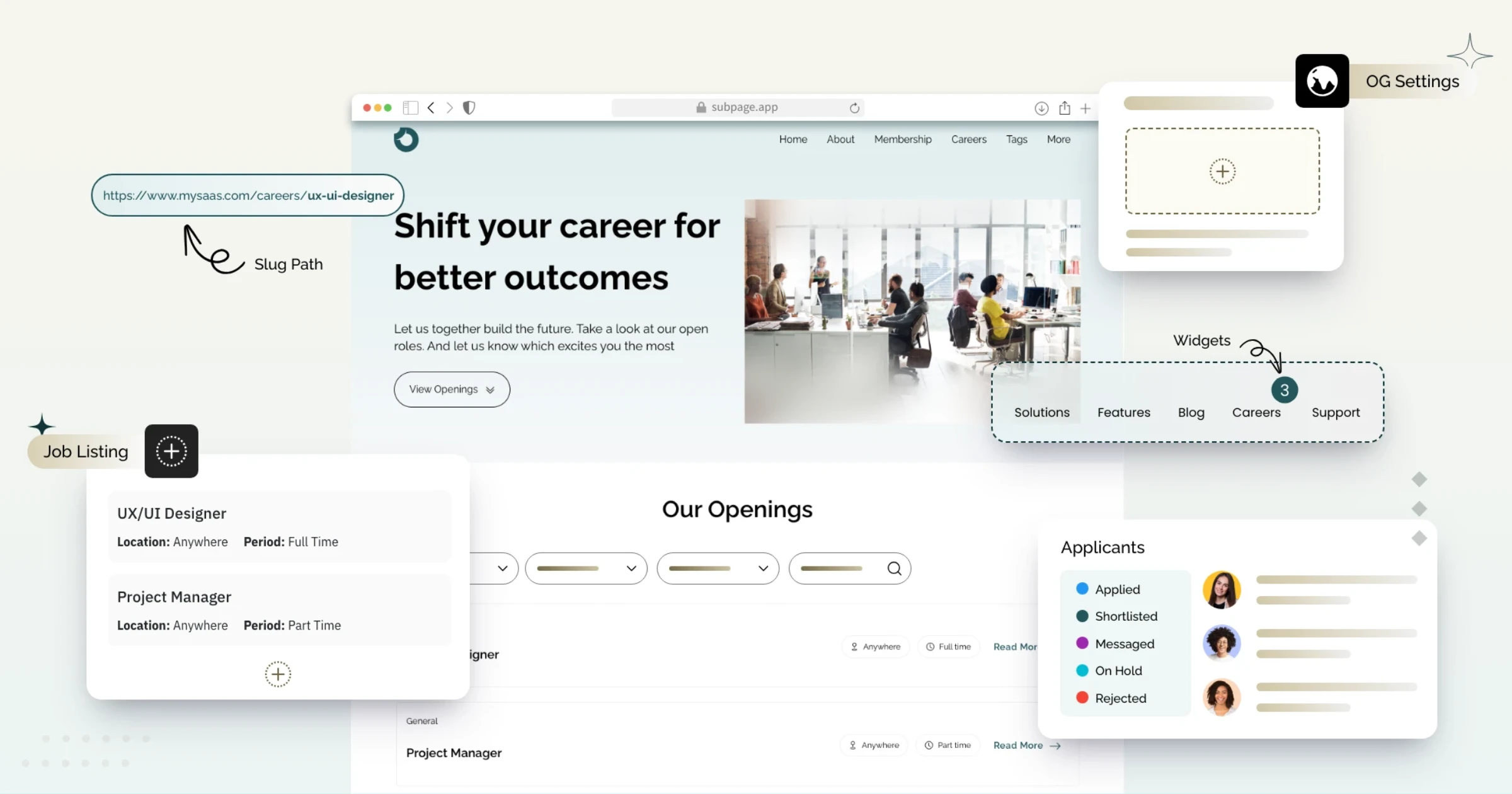
With SubPage, you can launch a branded careers page that is mobile-responsive, SEO-ready, and connected to a built-in applicant tracking system. Every role you post goes live on a page that reflects your brand. Every application comes into a structured pipeline where candidates can be tracked, communicated with, and moved forward without the chaos of email threads and spreadsheets.
SubPage also supports recruitment widgets that let you embed live job listings across your website, so your open roles are visible wherever candidates land — not just on the dedicated careers page. This is particularly useful for SaaS companies that want their homepage, product pages, or about page to passively support hiring at all times.
For small SaaS teams where hiring is important but not a full-time operational function, SubPage removes the complexity without removing the quality. You get a careers page that looks and performs like an enterprise one, at a fraction of the effort and cost.
To understand how this fits into a broader hiring setup, it is worth exploring how recruitment management software improves hiring efficiency for small and growing teams — and what to look for before committing to a system.
Conclusion
A careers page is not just a place where you list open roles. For a SaaS company hiring a small number of carefully chosen people, it is your first and sometimes only chance to make the right impression on the right candidate. It needs to be current, honest, easy to navigate, and built to serve both the external candidate who found you through a job board and the internal team member who is ready for a new challenge.
The best careers pages are not the most elaborate ones. They are the ones that clearly communicate who you are, what you offer, and how to take the next step — without making the candidate work for that information.
If you are ready to build a careers page that reflects the quality of your product and the culture of your team, sign up with SubPage and get started today.
