4 Aug 2026
7 Talent acquisition strategies for growing teams
Hiring is getting harder for lean teams before it gets easier. Robert Half's 2026 research found that 47% of small business leaders say finding skilled professionals is more difficult than it was a year ago — and the gap is widest for roles that require a specific mix of skills a job board alone can't surface. For small businesses and SaaS companies hiring a handful of roles at a time, that means the old playbook of "post and pray" no longer works.
This is where talent acquisition strategies come in. So what are talent acquisition strategies, exactly? They're the deliberate, long-term practices a company uses to identify, attract, and hire the right people — as opposed to reactive recruitment that just fills a seat. Done well, modern talent acquisition strategies in 2026 combine internal mobility, structured hiring, and a strong candidate-facing presence. Tools like SubPage make the last part easier by helping growing teams stand up a professional careers page without a dedicated design or engineering sprint.
Below are seven talent acquisition strategies for growing teams that punch above their weight — built for founders, HR leads, and small hiring teams, not enterprise recruiting departments.
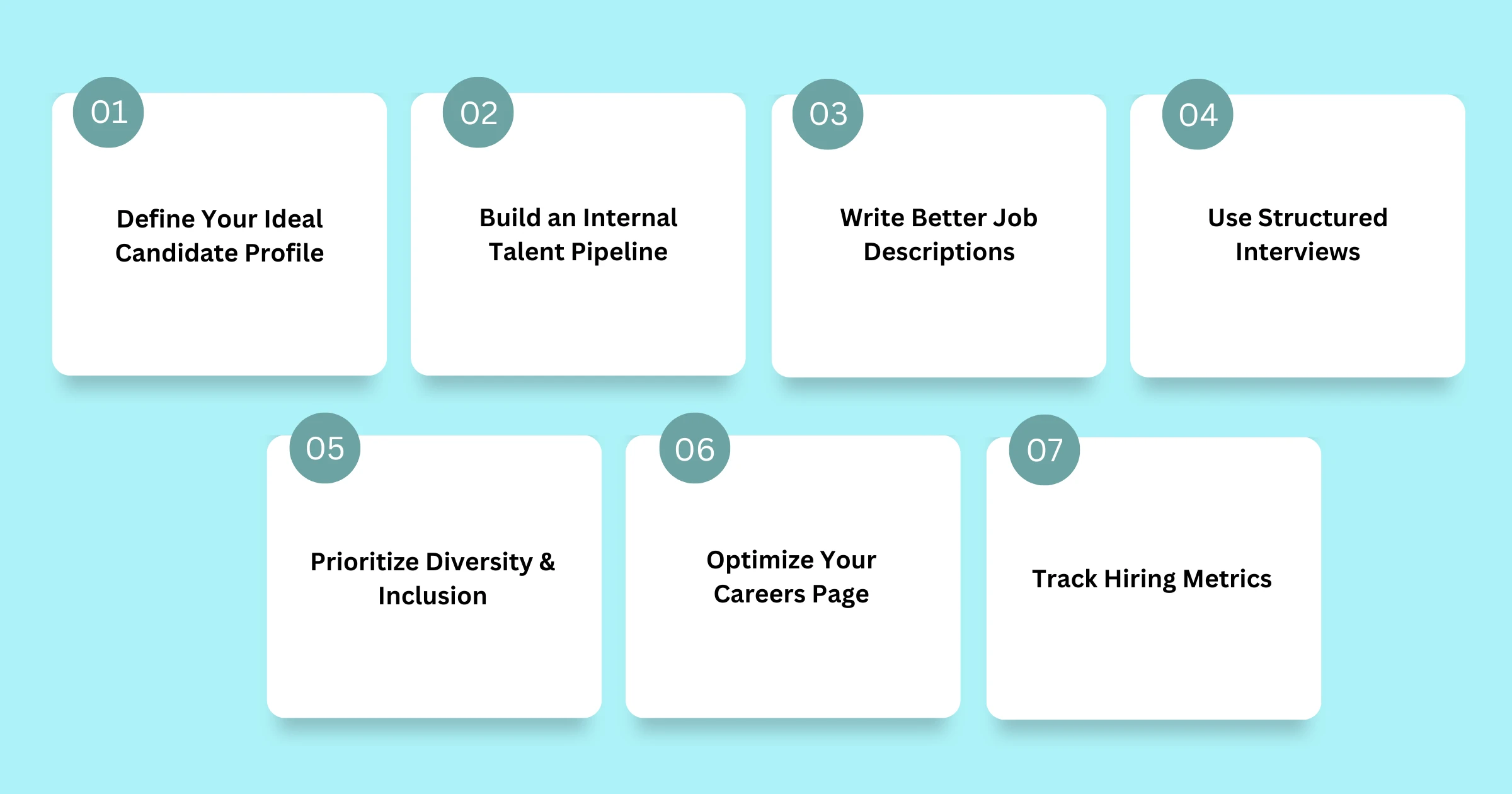
Define your ideal candidate profile before you post
The most common hiring mistake in growing teams isn't a weak candidate pool — it's an unclear target. Before writing a single job ad, get specific about the skills, experience level, and working style the role actually needs, not the wish list a founder wrote six months ago. Separate "must-have" from "nice-to-have," and involve the person the new hire will report to, not just HR.
This single step is the foundation of any real talent acquisition process — most terms in a talent acquisition glossary, from sourcing to screening, only work well when the target profile is already clear. Skipping it is why so many small businesses end up with 200 applicants and no obvious top three.
Write the profile down as a shared document, not a mental checklist. Include the specific problem the role solves in its first quarter, the two or three truly non-negotiable skills, and the traits that tend to succeed on your team versus the ones that quietly don't. A profile everyone on the hiring team can point to keeps scorecards consistent and stops "gut feel" from quietly overriding the criteria you agreed on at the start.
Build an internal talent pipeline first
Before sourcing externally, look inward. Internal promotion is faster, cheaper, and lower-risk than an external hire, and it signals to your whole team that growth is possible without leaving. Keep a running list of high performers interested in stretch roles, and pair this with a lightweight referral program — employees already understand your culture and tend to refer candidates who fit it.
An applicant tracking system makes this strategy realistic at scale, since it lets you tag internal candidates and referrals the same way you'd tag external applicants, rather than tracking them in a spreadsheet on the side. For a deeper look at how a full talent acquisition system supports pipeline-building alongside sourcing and screening, this guide to talent acquisition systems breaks down each stage.
Workforce planning makes this proactive rather than reactive. Once a quarter, map upcoming roles against the people already on your team who've expressed interest in growing into them, and be transparent about what "ready" looks like for each path. A referral program works the same way in reverse: instead of a generic "know anyone?" message, ask specifically for people who've worked well with your current team in the exact function you're hiring for. Specificity gets far better referrals than a blanket announcement ever will.
Write job descriptions that attract, not just inform
Most job descriptions read like legal disclaimers: a bulleted list of requirements with no sense of what the work or the team is actually like. Flip the structure. Lead with the problem the role solves and the impact the person will have in the first 90 days, then follow with requirements — kept to the 3-5 that actually matter.
Cut jargon, drop redundant "5+ years" requirements that filter out strong non-traditional candidates, and be upfront about salary range where you can. This one change to your hiring process often does more for application quality than any amount of extra sourcing.
It's worth testing more than one version. Try a shorter, benefits-forward draft against a more detailed one and see which pulls stronger applicants over a few postings — small teams rarely have the volume for a formal A/B test, but even an informal comparison across two or three roles will show you what resonates with the talent you're trying to reach.
Use structured interviews to reduce bias
Unstructured interviews — where every candidate gets a different set of questions based on how the conversation flows — are one of the least reliable predictors of job performance, and they leave far more room for unconscious bias to creep in. Structured interviews fix this: every candidate for a given role answers the same core questions, scored against the same rubric.
Build the rubric before the first interview, not after. Score independently, then compare notes as a panel. This is one of the simplest recruitment strategies to implement and one of the highest-leverage, since it improves both hiring accuracy and candidate experience at the same time.
Keep the panel small — two or three interviewers, each responsible for a distinct part of the evaluation, such as technical depth, collaboration style, or role-specific problem-solving. Overlapping panels tend to converge on the same superficial impressions instead of covering the full picture, and candidates notice when every interview asks the same shallow question in a slightly different way.
Build diversity and inclusion into your talent acquisition strategy
Diversity and inclusion shouldn't be a separate initiative bolted onto hiring — it belongs inside the core talent acquisition strategy itself. Practical talent acquisition diversity and inclusion strategies start earlier than most teams expect: writing job ads without gendered or exclusionary language, sourcing from platforms and communities beyond your existing network, and using the structured interview rubric above so every candidate is judged against the same standard.
Track where diverse candidates drop out of your funnel, not just how many enter it. A pipeline that's diverse at the top but narrows sharply by the final round usually points to a specific stage — often the interview panel or the informal "culture fit" gut-check — that needs a closer look.
For small teams without a dedicated DEI function, small structural changes tend to have an outsized effect: rotating who sits on interview panels, sourcing from at least one community or network outside your existing employee referrals each cycle, and reviewing anonymized scorecards before revealing names. None of this requires new headcount — it requires making the existing process a little more consistent every time it runs.
Optimize your careers page for conversions
Your careers page is often a candidate's first real interaction with your company, and for small teams it frequently gets less attention than the marketing site. That's a missed opportunity — a well-built careers page should function like a landing page: clear open roles, a short, honest description of culture and benefits, and a low-friction application process with no unnecessary form fields.
Photos and quotes from current employees consistently outperform generic stock imagery, and a fast, mobile-friendly apply flow reduces drop-off more than almost any other single change. For SaaS teams specifically, this breakdown of careers page best practices covers what to prioritize when engineering and design time is limited.
Treat the careers page as a living asset rather than a one-time build. Update open roles the same day a position closes, keep team photos current, and revisit the copy every couple of quarters as your culture and benefits evolve. A stale careers page — one advertising a role you filled months ago — quietly undermines the employer brand every other strategy on this list is trying to build.
Use data to track and improve your hiring funnel
You can't improve a hiring process you're not measuring. Track time-to-hire, offer-acceptance rate, source of hire, and drop-off rate at each stage of the funnel. Small teams often skip this because it feels like enterprise-scale overhead, but even a simple spreadsheet updated weekly reveals where candidates stall — whether that's a slow first response, a scheduling bottleneck, or a screening stage that's filtering out strong candidates.
This is one of the talent acquisition best practices that compounds over time: each hiring cycle gives you a clearer picture of which channels, job descriptions, and interview formats actually produce great hires. Recruitment planning gets easier every time you close the loop between a hiring decision and the data that led to it — and purpose-built recruitment tooling can automate most of this tracking rather than leaving it to a manual spreadsheet.
Review the numbers after every hire, not just once a year. If offer-acceptance rate is falling, the problem is often further upstream than compensation — a slow interview process or unclear next steps can cost you a candidate just as easily as a lower salary. Treating each hire as a small experiment, with a short debrief on what worked and what didn't, is what separates teams that improve their hiring funnel year over year from ones that repeat the same friction every cycle.
Bringing it together
Growing teams don't win by hiring more — they win by hiring smarter. A clear candidate profile, an internal pipeline, structured interviews, intentional diversity practices, a strong careers page, and a data-driven funnel together form a scalable hiring process that holds up as headcount grows, without requiring a full-time recruiting department to run it.
Start with the one or two strategies above that address your biggest current bottleneck, then build outward. Small, consistent improvements to your talent acquisition process add up faster than a single big overhaul.
Share: