How Recruitment Management Software Improves Candidate Experience
Hiring has quietly become a brand experience. According to SHRM research, a majority of candidates say a poor interview experience changes their opinion of a company they once respected — and many go on to share that experience with others. Recruitment management software exists to close that gap. It centralizes communication, automates repetitive tasks, and keeps candidates informed at every stage.
A well-designed careers page, like the ones built with SubPage, shapes the first impression — but what happens after a candidate applies is where recruitment software does its heaviest lifting, which is exactly what this article unpacks.
What is recruitment management software?
Recruitment management software is a platform that centralizes hiring activities — job postings, applicant tracking, interview scheduling, communication, and reporting — into one connected workflow. Instead of recruiters managing spreadsheets, inboxes, and calendar invites separately, the software ties these pieces together so candidates move through a consistent, trackable process.
Most modern platforms combine applicant tracking system (ATS) functionality with recruitment automation features: automated status updates, interview self-scheduling, structured feedback collection, and candidate communication tools. The goal isn't just internal efficiency — it's making the entire hiring process feel coherent from the candidate's side of the screen.
Why candidate experience matters in recruitment
Candidate experience isn't a soft metric anymore. Research from CareerBuilder has found that a large share of job seekers say the overall hiring experience signals how a company treats its employees — meaning candidates judge your culture long before they're hired into it.
The cost of getting it wrong is concrete. Slow, opaque, or disorganized hiring processes lead to candidate drop-off, lost offers to faster-moving competitors, and damaged employer reputation on review sites.

We've covered the foundations of candidate experience and how a careers page sets the tone in our dedicated guide on candidate experience — this article picks up from there and focuses on the software layer that keeps that experience consistent once a candidate applies.
How recruitment management software improves the candidate experience
Faster, more transparent communication
Recruitment automation removes the biggest source of candidate frustration: silence. Automated acknowledgment emails, status-change notifications, and scheduled check-ins mean candidates aren't left guessing whether their application disappeared into a black hole. Recruiters no longer have to manually update every applicant — the system does it the moment a stage changes.
Streamlined application and interview scheduling
Manually coordinating interview times across recruiters, hiring managers, and candidates is one of the most time-consuming parts of any recruitment workflow. Recruitment software with built-in scheduling tools lets candidates pick available slots directly, cutting out the back-and-forth email chains that stretch a hiring timeline by days or weeks.
Personalized candidate journeys
Modern recruitment management software allows teams to tailor communication based on role, stage, or candidate source. A senior engineering candidate and an entry-level support applicant don't need to receive the same generic template — recruitment technology lets recruiters segment and personalize messaging at scale, something that's nearly impossible to maintain manually once volume grows.
Reduced candidate drop-offs through automation
Long, clunky application forms and unclear next steps are leading causes of candidate abandonment. Recruitment software simplifies the application flow, sends automated reminders for incomplete steps, and keeps candidates engaged between stages — directly addressing how hiring software reduces candidate drop-offs rather than leaving that problem to chance.
Better feedback loops and status updates
Recruitment platforms often include structured interview feedback tools, letting hiring teams log evaluations quickly and move candidates forward without delay. The faster internal feedback moves, the faster candidates get a real answer — which is consistently one of the top candidate complaints in hiring surveys.
Mobile-friendly and accessible hiring workflows
A large share of job seekers now browse and apply for roles from a phone. Recruitment management software built with mobile-responsive application flows and scheduling tools meets candidates where they already are, rather than forcing them onto desktop-only portals that quietly push qualified applicants away.
Data-driven improvements to the hiring process
Recruitment software doesn't just run the process — it reports on it. Time-to-hire, drop-off points, and interview-to-offer ratios become visible metrics rather than guesswork. Recruitment teams can use this data to keep refining the recruitment workflow, turning candidate experience into something measurable and improvable over time.
Recruitment software vs manual hiring process
A manual recruitment process — spreadsheets, shared inboxes, ad hoc scheduling — can work at a very small scale, but it breaks down quickly as application volume grows. Communication delays multiply, feedback gets lost between hiring managers, and candidates experience inconsistent treatment depending on which recruiter handles their file.
Recruitment management software replaces that fragmentation with a single source of truth. Every candidate interaction, status change, and piece of feedback lives in one place, which means the experience stays consistent whether a company is hiring for one role or fifty.
Best practices for improving candidate experience with recruitment technology
Recruitment software is a tool — how it's configured determines how much it actually improves candidate experience. A few practices make the difference:
- Set automated status updates at every major stage, not just application and rejection
- Keep application forms short and only ask for information you'll actually use
- Use scheduling tools to let candidates choose interview times directly
- Standardize feedback templates so internal review doesn't slow down candidate communication
- Review drop-off data quarterly to spot friction points in the recruitment process
- Personalize key touchpoints — even automated messages can include role-specific detail
These practices turn recruitment automation from a convenience feature into a genuine driver of the hiring experience.
Choosing the right recruitment management software
The right platform depends on hiring volume, team structure, and how much of the recruitment workflow needs automation versus human judgment. Beyond the core feature set, a few additional things are worth checking before committing to a platform:
- Vendor support and response times — when a scheduling glitch or integration hiccup happens mid-hiring-cycle, slow support directly delays candidates waiting on updates
- Data security and compliance — candidate information includes personal and sometimes sensitive data, so look for clear data-handling and privacy practices, especially if hiring across regions
- Trial-testing as a candidate, not just a recruiter — submit a test application yourself to feel the actual flow your applicants will experience, not just the admin dashboard
- Team adoption curve — a powerful platform only improves candidate experience if hiring managers and recruiters actually use it consistently; overly complex tools often get bypassed
- Reporting depth tied to candidate experience — beyond basic time-to-hire, check whether the platform surfaces stage-by-stage drop-off data, so you can pinpoint exactly where candidates disengage
- Flexibility to evolve with hiring volume — a system that works for five hires a year should still hold up cleanly at fifty, without forcing a platform switch mid-growth
At minimum, also confirm the platform offers strong candidate communication tools, flexible scheduling, and reporting that surfaces where candidates disengage — these are non-negotiable baseline requirements.
This decision deserves more depth than a single section can offer — for a full breakdown of evaluation criteria and what to prioritize, see our guide on choosing a recruitment management system: what every company should know.
Building a strong candidate-facing front door with SubPage
Recruitment management software handles what happens after someone applies — but the moment before that, when a candidate first lands on your careers page, matters just as much. That's the layer SubPage is built for: a fast, branded careers page that sits in front of your recruitment workflow and gives candidates a clean, professional first impression before they ever enter your applicant tracking system.
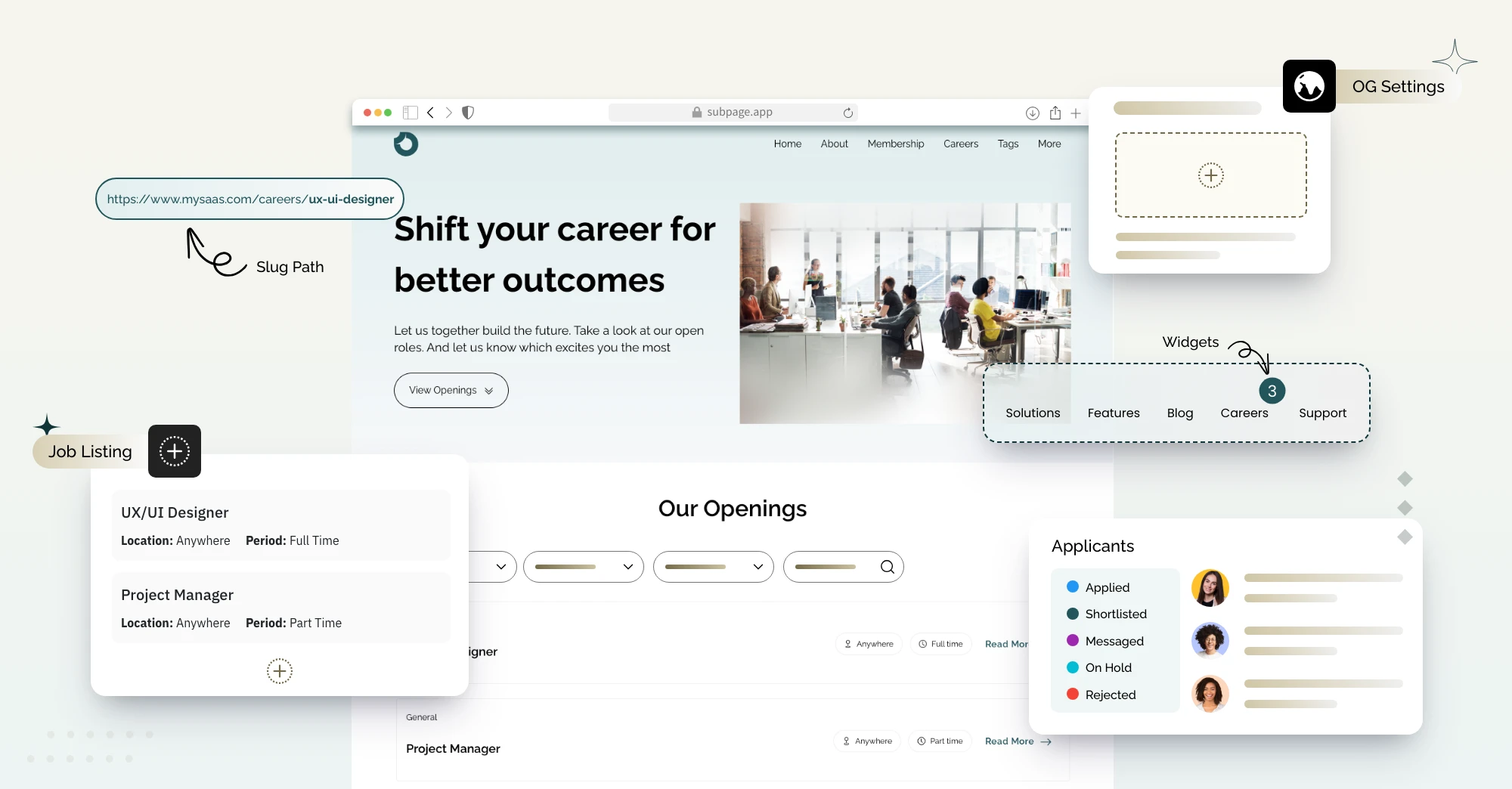
Instead of routing candidates to a generic, templated job board page, teams use SubPage to design a careers presence that matches their brand and connects directly into their existing hiring tools. A few things shape why this front door matters as much as the workflow behind it:
- First impressions set expectations — a careers page that looks rushed or generic signals a disorganized hiring process before a candidate even applies, regardless of how smooth the actual workflow is behind the scenes
- Load speed affects drop-off before the application even starts — a slow or clunky careers page loses candidates at the very top of the funnel, before recruitment software ever gets the chance to engage them
- Brand consistency builds trust — when the careers page visually matches the rest of a company's site, candidates read it as a sign of legitimacy, rather than feeling routed to a third-party job board
- A clear path forward reduces friction — open roles, clear job descriptions, and an obvious next step keep candidates moving instead of bouncing to search elsewhere
- It connects rather than replaces — the careers page isn't a standalone asset; it feeds directly into the recruitment workflow, so the polish at entry carries through to the structured process candidates experience afterward
It's the presentation layer that complements recruitment software — making sure the experience candidates have during the hiring process actually starts from the very first click, not just from the moment they submit an application.
Conclusion
Candidate experience isn't built on goodwill alone — it's built on systems that keep communication fast, scheduling simple, and feedback timely. Recruitment management software addresses each of these mechanically, turning a process that used to rely on manual follow-up into one that runs consistently at any scale.
If you're ready to give candidates a hiring experience that matches the quality of your team, sign up free with SubPage and start building it today.