Why SaaS Companies Need More Than a Traditional Blogging Platform
Blogging still works. According to Blogging Wizard, companies that run their own blog generate 67% more leads than those that don't have one. The case for blogging isn't in question — what's increasingly in question is whether the platform underneath that blog can keep up.
Most SaaS teams inherited their blog from whatever CMS the marketing site happened to run on when the company was founded, a decision that made sense at the time but was never built for how SaaS companies operate today: fast release cycles, distributed marketing teams, and a product that changes every sprint while the blog stays frozen in place. A SaaS blogging platform — built specifically for this kind of company rather than adapted from general-purpose software — solves problems a generic blog was never designed to handle. Tools like Subpage's blog builder exist precisely because of this gap, giving SaaS and small business teams a way to publish, structure, and scale content without fighting their own tech stack.
This article breaks down where traditional blogging platforms fall short for SaaS, what a modern platform looks like in practice, and how to evaluate one before you commit to it.
What a traditional blogging platform actually is
A traditional blogging platform is a general-purpose content management system — think a standard WordPress install, a bare-bones Ghost site, or a blog bolted onto a website builder as an afterthought. These tools were designed for a simple job: let anyone publish a post to the internet, quickly and cheaply. That's still what they do well, and it's why they remain popular for personal sites, hobby blogs, and small publishers with modest ambitions.
What they were never designed for is the actual purpose a business blog serves today — driving qualified organic traffic, supporting a product-led sales motion, and functioning as a connected part of a company's website rather than a separate satellite orbiting it. A blog's job has quietly shifted from "publish content" to "convert strangers into pipeline," and most traditional platforms were frozen in place before that shift happened.
The gap shows up in small, frustrating ways at first: a plugin update breaks the layout, a developer has to fix a broken redirect, or a marketer waits three days for an engineering ticket just to publish a time-sensitive post. Individually, none of these feel like a crisis. Compounded over a year of content production, they add up to a real tax on growth — one paid in missed publishing windows, lost SEO momentum, and marketing hours spent managing software instead of writing.
For a five-person team writing occasional personal essays, none of this matters much. For a SaaS company competing for commercial search terms against dozens of well-funded competitors, it matters a great deal — because every day a post sits in a publishing queue is a day a competitor's post could be earning the ranking instead.
Why SaaS companies need a modern blogging platform
SaaS businesses have a specific set of constraints that traditional blogging tools consistently struggle with:
- Publishing speed. SaaS marketing teams need to ship content as fast as product ships features — changelog explainers, comparison pages, use-case posts. A CMS that requires a developer to touch templates or fix broken plugins before every publish becomes a bottleneck, not a channel.
- SEO control from the ground up. Generic blogging platforms treat SEO as an afterthought, bolted on through third-party plugins. A modern SEO blogging platform builds metadata, clean URL structures, internal linking, and page speed into the foundation, not as an optional add-on.
- Integration with the product site. A blog living on a different subdomain, theme, or codebase than the rest of the website creates a disjointed experience and dilutes domain authority. SaaS companies need their blog to feel and perform like a native part of their site, not a separate project.
- Collaboration without engineering dependency. Marketing, content, and growth teams need to publish, edit, and restructure content without opening a support ticket with engineering every time something needs to change.
- Content that scales with growth. As a SaaS company adds products, personas, and markets, content volume grows fast. Platforms built for a handful of static pages start to buckle under hundreds of posts, categories, and interlinking requirements — exactly the point where a business most needs its content system to hold up.
- Purpose-built marketing tooling, not general software. Most legacy CMS products were never built with marketing outcomes in mind — they were built to publish text. A platform designed around SaaS marketing tools thinks in terms of funnels, conversion paths, and content-to-signup journeys from the start, not as bolted-on extensions.
These aren't nice-to-haves. They're the difference between a blog that compounds into a real growth channel and one that quietly stalls out after the first fifty posts. This is exactly why the search for the best blogging platform for SaaS companies has become its own category of research — teams have learned the hard way that "any CMS will do" doesn't hold up once content becomes a real growth lever.
Traditional blogging platform vs SaaS blogging platform
Capability | Traditional blogging platform | SaaS blogging platform |
SEO controls | Plugin-dependent, inconsistent | Built-in metadata, structure, and speed |
Publishing speed | Slower, often needs developer support | Fast, marketer-owned workflow |
Integration with product site | Separate theme/subdomain, disjointed | Native, unified with the main site |
Collaboration | Limited roles, clunky editing | Built for marketing teams to move independently |
Scalability | Struggles past a few hundred posts | Designed for growing content libraries |
Design and branding consistency | Requires custom dev work to match brand | Matches site design out of the box |
Content ownership | Split between marketing and engineering | Fully owned by the marketing team |
Time to launch new content types | Slow, requires custom template work | Fast, flexible content structures |
Looking at this side by side, the differences aren't cosmetic — each row represents a recurring point of friction that shows up weekly for a marketing team running on the wrong infrastructure. A missing SEO control isn't a one-time inconvenience; it's a small tax paid on every single post, forever, until the platform changes.
The pattern is consistent: a business blogging platform built for general use asks a SaaS team to work around its limitations. A platform built specifically for SaaS content removes the workaround entirely, instead of asking marketing to compensate for gaps in the underlying software.
This distinction matters even more for B2B SaaS companies, where buying cycles are longer, content needs to support multiple stakeholders in a deal, and search competition is dense with well-resourced competitors. A blogging platform for B2B SaaS companies has to hold up not just for a single blog post, but across an entire library built to move a buyer from first search to signed contract. Traditional tools were never stress-tested against that kind of demand, because they were built before "content library as a sales asset" was a common expectation.
The practical result is that teams on legacy platforms often end up quietly under-publishing. Not because they lack ideas, but because every additional post adds more maintenance overhead to a system that was already straining. A platform built for SaaS from the outset removes that ceiling, so content output can scale in line with the business rather than being capped by the software underneath it.
How to choose a blogging platform for SaaS
Not every "modern" blogging tool is actually built for SaaS. When evaluating options, look past the marketing page and check for these specifics:
1. Native SEO tooling. Confirm the platform functions as a genuine blog platform with SEO for SaaS built in — handling meta titles, descriptions, canonical tags, sitemaps, and clean slugs without requiring a separate plugin ecosystem that breaks on every update.
2. Speed to publish. Ask how long it takes a non-technical marketer to go from draft to live post. If the answer involves a developer, that's a bottleneck waiting to happen the first time a competitor beats you to a trending topic.
3. Interlinking and content organization. A content management for SaaS use case means dozens or hundreds of related posts, not a handful of static pages. The platform should make it easy to categorize, tag, and cross-link content without manual HTML editing every time the content library grows.
4. Analytics tied to content performance. You should be able to see which posts drive traffic, signups, and engagement — not just raw pageviews in a generic dashboard disconnected from your actual product and signup data.
5. Design and brand consistency. The blog should look like it belongs to the same company as the product site, not a separate WordPress theme someone picked years ago and never revisited.
6. Room to grow. Check how the platform performs at scale — hundreds of posts, multiple contributors, and evolving categories — not just how it looks with five sample posts in a demo environment.
7. True ownership over content structure. A capable SaaS blog management platform should let a marketing team restructure categories, update old posts, and manage a growing content platform for SaaS businesses without needing a developer's sign-off for routine changes.
What small businesses and SaaS teams should expect from a content platform?
Not every company facing this problem is a venture-backed SaaS business with a dedicated engineering team on standby. A lot of the same pain shows up for small business owners running a lean marketing function, where "just ask a developer" isn't a realistic option at all. For these teams, a content platform for SaaS businesses needs to do double duty: it has to be powerful enough to compete on SEO, but simple enough that one or two people can run it without specialized technical skills.
That combination — real SEO capability plus genuine ease of use — is where most traditional tools fail small teams specifically. Enterprise-grade CMS platforms are often too complex to self-manage, while free website builders are usually too limited to rank competitively. A modern SaaS blogging platform is built to sit in the middle: enough structure and SEO power to compete with larger competitors, without requiring a specialized hire just to keep the blog running.
Benefits of an all-in-one content platform for SaaS companies
When SaaS teams move to a platform purpose-built for their content needs, the benefits show up in a few consistent places:
- Faster organic growth. SEO-first architecture means new posts start earning visibility sooner, instead of fighting a platform's technical debt just to get indexed properly.
- Stronger lead generation. Content built with clear structure, internal linking, and conversion paths turns readers into a pipeline more reliably than a disconnected blog that was never designed with conversion in mind.
- More content velocity, less friction. Marketing teams publish independently, which means more consistent output without waiting on engineering resources or fighting a broken publishing workflow.
- Lower long-term cost. Fewer plugins, less custom development, and less time spent maintaining a fragile CMS setup add up to meaningful savings once measured over a full year of content operations.
- Brand consistency across every page. A blog that looks and feels native to the product builds more trust with prospects doing due diligence before a purchase decision, rather than raising subtle doubts about how well-run the company is.
- Reduced dependency on developers and IT. Marketing owns the publishing pipeline end to end, freeing engineering time for the product itself instead of routine content maintenance.
- For teams that have already invested in a strong SaaS content marketing strategy, the platform is often the missing piece — not the strategy itself. Good ideas executed on the wrong infrastructure still underperform.
It's worth revisiting how your team currently tracks blog performance once the platform changes, since better infrastructure usually surfaces metrics that were previously invisible, and often reveals which posts were quietly underperforming because of technical issues rather than weak content.
Alternatives to traditional blogging platforms for SaaS
The market has responded to this gap. A newer category of content publishing platforms has emerged specifically to serve SaaS and small business teams who need something faster and more integrated than a legacy CMS, without the overhead of building and maintaining a custom solution from scratch.
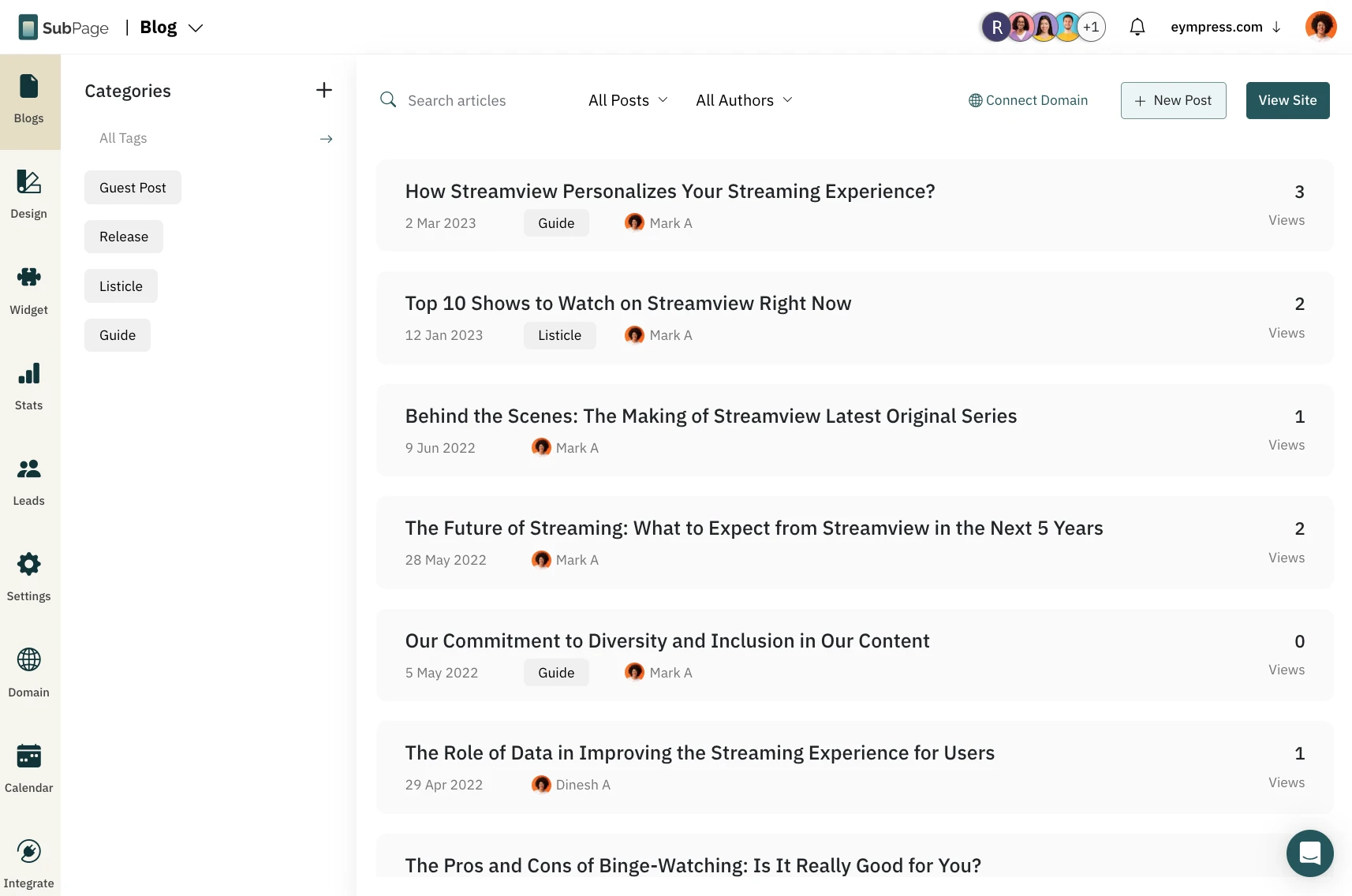
Subpage's blog builder is one example of this category — designed so SaaS marketing teams can launch, structure, and grow a blog that's native to their existing site, with SEO fundamentals built in from day one rather than patched on later. Instead of treating the blog as a separate project bolted onto the company website, it treats content as a core, connected part of the product experience, complete with the interlinking, categorization, and publishing speed that a growing library needs.
This is also where it helps to think beyond the blog itself and revisit the fundamentals of what makes content effective in the first place — teams weighing platform alternatives often benefit from reviewing broader content marketing tactics for SaaS alongside the infrastructure decision, since the two reinforce each other.
If your team is still deciding between a quick migration and a full platform switch, it's worth comparing the operational cost of staying versus the compounding upside of switching early. Most teams find the break-even point arrives faster than expected once publishing speed, SEO performance, and reduced engineering dependency are factored into the comparison.
The bottom line
Traditional blogging platforms were built for a different era of content — one where publishing a post was the whole job, and nothing more was expected of it. SaaS companies now compete on organic visibility, publishing speed, and a content experience that feels native to their product, not bolted onto it as an afterthought. That's exactly the gap a modern SaaS blogging platform is built to close, and it's a gap that only widens the longer a company waits to address it.
The teams that treat their blog as core infrastructure — not a side project running on borrowed software — are the ones compounding organic growth quarter over quarter, while everyone else pays a slow, invisible tax on every post they publish. Choosing the right platform doesn't just fix a technical annoyance; it removes a ceiling on how far content can actually take the business.
If your current setup is holding your content back rather than helping it scale, it's worth evaluating a platform designed for exactly this problem. Sign up free with Subpage and start building a blog made for SaaS growth — no developer required.