28 Jul 2026
Blog Platform Features Every SaaS Company Needs
Every SaaS company eventually asks the same question: is our blog actually working, or is it just filling a content calendar? The right blog platform can be the difference between a blog that quietly stalls and one that compounds into a real growth channel. According to First Page Sage's 2025 SEO ROI research, SEO delivers a 702% ROI for B2B SaaS companies over three years, one of the highest returns available in marketing. That kind of return only shows up when the platform underneath the blog can support it instead of fighting against it.
Many SaaS teams reach for tools like SubPage's blog builder because generic CMS software was never built with this kind of growth math in mind. Before evaluating any platform, it helps to revisit what a blog is meant to achieve in the first place, since the right feature set depends on the job the blog is meant to do. From there, this guide walks through the SEO tools, performance standards, workflow features, analytics, and scalability every SaaS blog platform should offer.
The core blog platform features SaaS companies need
Generic content management system (CMS) software was built to publish text, not to support a modern growth engine. That gap between what a blog needs to do and what a bare-bones CMS was designed for is exactly why a specialized blog platform for SaaS exists, and we've covered the deeper case for that shift elsewhere. Here, the focus is narrower: the specific features that separate a blog platform that helps a SaaS company grow from one that holds posts.
At a minimum, a serious SaaS blogging platform should offer:
- Native SEO controls, not bolted-on plugins
- Fast load times that hold up under Google's performance standards
- Editorial workflow tools built for marketing teams, not developers
- Analytics tied directly to content performance, not just pageviews
- Custom domains and design flexibility as the company scales
Every section below unpacks one of these in more detail. Teams building a blog with SubPage get most of this out of the box, which is part of why the platform decision matters more than most SaaS teams initially assume. A blog is infrastructure, and the wrong infrastructure quietly caps how far content can take the business.
Built-in SEO tools that drive organic growth
On-page SEO is the feature category most SaaS teams check first, and for good reason. SEO (search engine optimization) determines whether a blog post ever reaches the audience it was written for, and a content management platform for SaaS should make good SEO the default, not an advanced setting.
Look for a platform that handles these natively:
- Editable meta titles and descriptions on every post
- Clean, keyword-friendly URL slugs without forced parameters
- Automatic sitemap generation and submission
- Schema markup for articles, so search engines understand the content correctly
- Canonical tags to prevent duplicate content issues across a growing library
An SEO-friendly blog platform for SaaS removes the need for a separate plugin ecosystem just to get these basics right. That matters because SEO compounds. A post published with clean technical fundamentals today keeps earning organic traffic months and years later, while one built on a shaky foundation needs constant manual fixes just to stay visible. For a company evaluating the best blog platform for SaaS companies, native SEO tooling isn't a nice-to-have. It's the feature that determines whether the other categories in this guide even get a chance to matter.
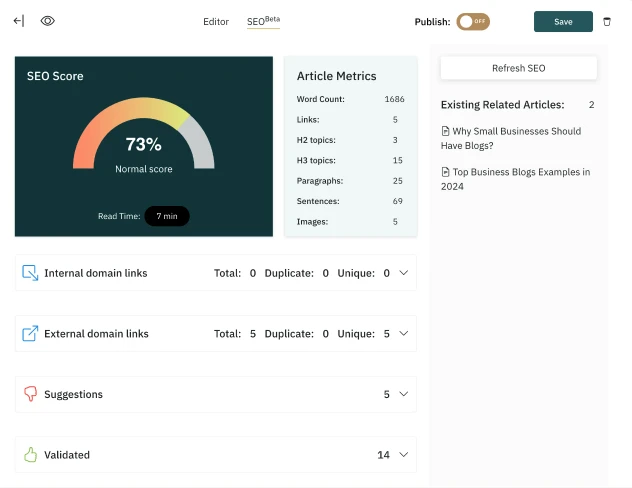
Some platforms take this further with an automated SEO report card that flags thin content, missing links, or weak metadata before a post goes live. SubPage's editor works this way, pairing an AI SEO review with sub-directory publishing, so the blog lives at
yourdomain.com/blog instead of a disconnected subdomain that dilutes link equity.Why performance and speed are non-negotiable
Search engines and site visitors both punish a slow blog, and SaaS companies have less room for error here than most. Core Web Vitals, Google's set of measurable page experience metrics, directly affect search rankings, and a blog that loads slowly drags down the entire domain's SEO performance, not just the blog itself.
Speed also affects the metric SaaS marketers care about most: conversion rate. A visitor who lands on a slow blog post is less likely to stick around long enough to click through to a signup page, no matter how good the content is. A blog platform with analytics and SEO for SaaS built in should let a team see how page speed correlates with reader behavior, not just how fast a page loads in isolation.
When evaluating platforms, ask how they handle image optimization, caching, and mobile rendering, since these three factors account for most real-world speed problems. A platform that treats speed as a core requirement, not an afterthought fixed after launch, saves a marketing team from chasing performance issues post by post, which is a big part of what separates essential blog platform features for SaaS from cosmetic ones.
SubPage, for instance, handles image optimization and page loading automatically and publishes layouts that are W3C verified, so rendering stays consistent across browsers without a developer auditing every release.
Content workflow and collaboration features
Content rarely comes from one person for long. As a SaaS company's blog grows, so does the number of people touching it, which makes workflow features a practical requirement rather than a convenience.
A capable blog management software should support:
- An editorial calendar for planning posts across weeks or months
- Multi-author support with clear attribution
- Draft, review, and publish states that prevent half-finished posts from going live
- Role-based access, so writers, editors, and admins each see only what they need
These features matter most under time pressure. When a launch date moves up, or a competitor publishes first, a team needs to move a post from draft to live without waiting on a developer. Blogging tools for businesses that make this smooth free up marketing time for what actually grows the blog: writing better content and fixing what isn't performing.
Collaboration matters for consistency too. A shared style guide and a single source of truth for drafts keep a growing team from duplicating work or publishing off-brand posts. None of this shows up in a demo with two sample articles. It shows up six months in, once the content library and the team behind it have both grown, which is exactly when knowing how to choose a blog platform for SaaS pays off.
A few features save real hours every week: real-time shared editing with inline review comments, so contributors resolve feedback in the same draft instead of emailing versions back and forth, plus post scheduling so a piece goes live at the right moment without anyone remembering to hit publish manually. SubPage also bundles an AI writing assistant for outlines and first drafts alongside a built-in plagiarism checker, confirming originality before a post ships rather than after it's flagged.
Analytics and content performance tracking
Publishing content without tracking its performance is a bit like running ads without checking the results. A content management platform for SaaS should make it easy to see which posts drive real outcomes, not just traffic.
Built-in analytics and third-party tools like GA4 each have a role to play. Native analytics tied directly to the blog show which posts readers actually finish and which internal links they click, data a general-purpose analytics tool rarely surfaces cleanly. GA4 and similar integrations add the broader picture: where traffic originates, how it moves through the rest of the site, and where it ultimately converts.
For SaaS companies, the metrics that matter go beyond pageviews:
- Which posts drive trial signups or demo requests
- How organic traffic to the blog compares month over month
- Which topics keep bringing readers back to the site
- Where readers drop off before reaching a call to action
A platform positioned as the best CMS for SaaS content marketing treats these as first-class metrics, available through a blog platform with analytics and SEO for SaaS in one place, not an export a marketer has to stitch together manually every month. That distinction saves hours and, more importantly, surfaces the posts worth doubling down on.
Lead capture is the other half of this picture. Newsletter signup forms and gated resources like ebook or template downloads turn anonymous readers into contacts a sales team can follow up with, and lead capture metrics inside the same dashboard show which posts actually generate pipeline, not just traffic.
Customization, branding, and scalability for growth
A blog that looks like it belongs to a different company than the product it supports quietly undermines trust while a prospect does due diligence. Custom domains, matching design systems, and white-label options solve this by letting the blog live on the company's own domain rather than a generic third-party address.
For a business blogging platform to hold up over the long term, it needs to grow with the company that uses it. That means:
- Support for hundreds of posts without slowing down
- Flexible categories and tags that stay organized as the library expands
- Design components that adapt as the brand evolves
- Room for new content types, like comparison pages, guides, and changelogs, without a rebuild
This is especially important for blog software for growing SaaS startups, where a blog that launches with five posts might need to support five hundred within a couple of years. A SaaS marketing platform built with this trajectory in mind avoids the painful mid-growth migration many teams face once their original CMS choice can't keep up. Scalability isn't a future problem to solve later. It's a feature worth checking for before the first post ever goes live.
Smaller reader-facing details add up too: a library of ready-made layouts that can be swapped without losing content, a built-in image editor, and extras like an RSS feed, dark mode, and native integrations such as Zapier that connect the blog to the rest of the marketing stack.
The bottom line
Choosing a blog platform is a growth decision, not just a publishing decision. Built-in SEO, real performance standards, workflow tools, meaningful analytics, and room to scale are what separate a blog that compounds into a genuine growth channel from one that quietly stalls after the first few dozen posts. Any team weighing the best blog platform for SaaS companies should treat this list as a checklist, not a wish list.
For more on getting the content strategy right once the platform is in place, SubPage's blog covers the tactics that pair well with strong infrastructure, and it's worth a look before you finalize a decision.
Ready to launch an SEO-friendly blog for your SaaS product? Start with SubPage, built for teams who take content seriously.
Share: