How SaaS Companies Can Use Blog Content to Educate Users
If you run a SaaS business, you already know the challenge: your product might be incredibly powerful, but if users don't understand how to get the most out of it, they'll churn — and fast. Here's a number worth sitting with: SaaS companies lose 13% of their customers annually due to poor onboarding experiences.
A well-structured SaaS company blog isn't just a content checkbox. It's a user education engine that works around the clock. Whether you're explaining a core feature, answering a common support question, or walking users through a workflow, the right blog content builds confidence — turning hesitant new users into power users who stick around.
In this guide, we'll walk through exactly how SaaS companies can use blog content to educate users at every stage of the journey, and how tools like SubPage make it easier to build and manage that blog without any technical headache.
Why user education through a SaaS blog actually works
Before we get into tactics, it's worth understanding why a SaaS company blog is such a powerful education channel in the first place.
Unlike one-time onboarding emails or help docs buried in a sidebar, blog content is discoverable. Users who have a question about your product — or a general problem your product solves — will search Google first. If your blog answers that question, you win on two fronts: organic traffic and a better-informed user.
There's also a trust dimension here. When users find genuinely helpful content on your blog, it signals that your company cares about their success, not just their subscription. That kind of trust has a direct impact on loyalty. And the SEO benefits compound — for SaaS businesses where customer acquisition costs are high, a growing library of searchable content is a long-term competitive advantage that keeps paying off.
What types of blog content educate users best
Not all content is created equal when it comes to user education. Here's a breakdown of the formats that consistently deliver.
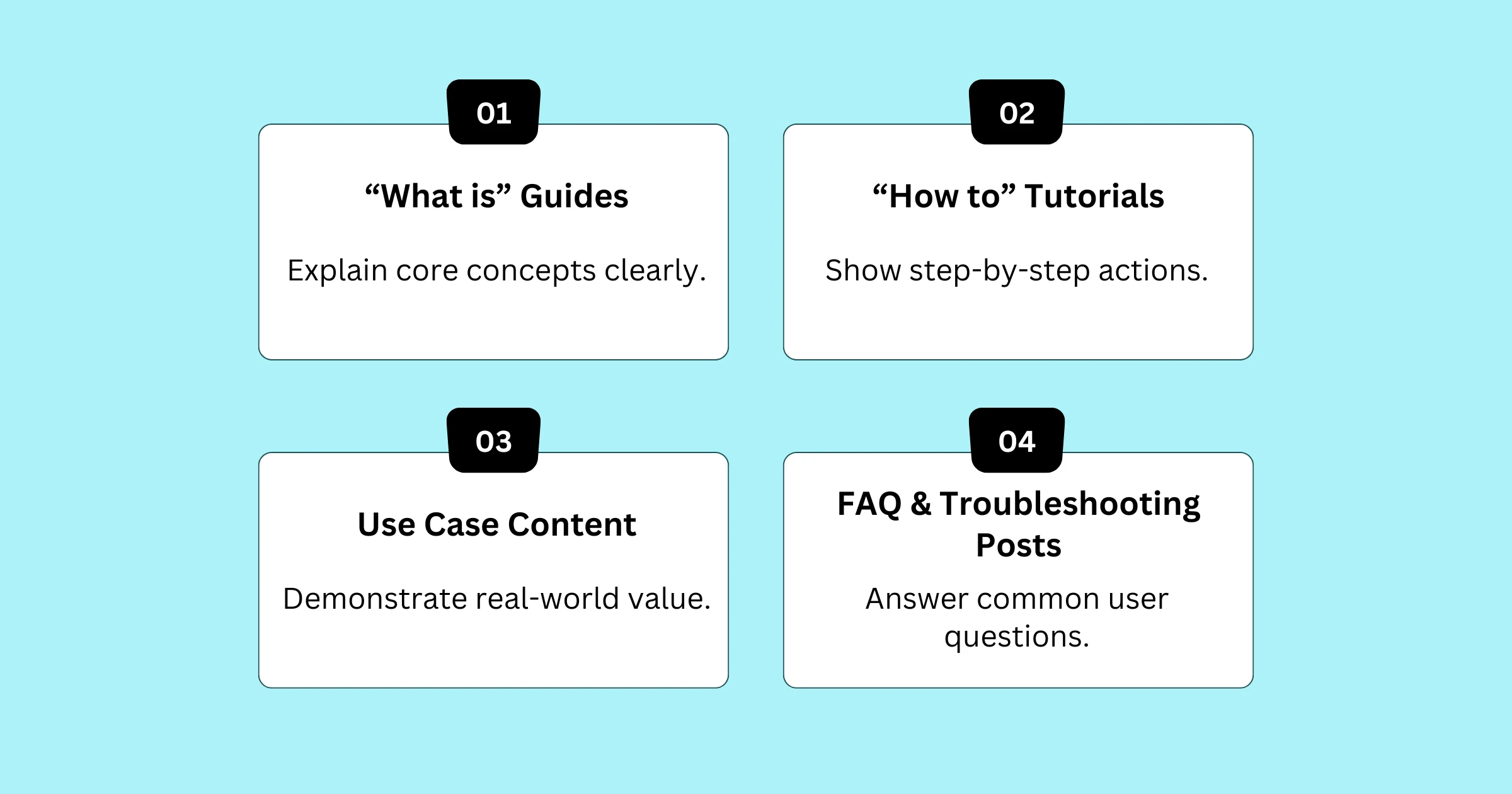
"What is" guides
"What is" content helps new users understand core concepts before they dive into your product. If your platform involves workflows, integrations, or terminology that's unfamiliar, don't assume users already have the context. A post like "What is a changelog page and why does your SaaS need one?" doesn't just rank well on Google — it pre-educates prospects before they even sign up, making onboarding smoother from day one.
"How to" tutorials
"How to" content is where things get practical. These posts walk users through specific tasks inside your product or the broader context of their work. "How to create a blog page for your SaaS website in 10 minutes" is infinitely more actionable than a vague feature overview. The key is to write these posts with genuine usefulness in mind, not promotion. Users can tell the difference — and if your tutorial reads like a sales pitch, the opportunity is lost.
Use case content
Use case posts show users how others are getting value from your product in real-world scenarios. These work especially well for mid-stage and existing users who are looking for ways to go deeper. They answer the question every SaaS user eventually asks: "Am I getting everything I could from this?"
FAQ and troubleshooting posts
Every SaaS support inbox has a shortlist of questions that come in week after week. Turning these into well-structured blog posts creates a self-service resource that scales. If your support team answers the same question ten times a week, that's ten users who couldn't find the answer on their own — and a blog post that could change that.
How to map blog content to the user journey
One of the smartest things a SaaS company can do is structure its blog content around the stages users actually move through — not just publish content and hope for the best.
- Awareness stage content introduces broad concepts that connect to your product's value. Think industry trends, common pain points, and foundational knowledge. Users at this stage aren't ready to go deep on features — they're still working out whether they have the problem you solve. Your content here should be genuinely educational, not product-forward.
- Consideration stage content helps users who know they have a problem and are evaluating their options. This is where comparison posts, checklists, and "what to look for in a [product category]" guides shine. Your blog becomes a trusted guide through a decision they're already making.
- Retention stage content is where most SaaS companies drop the ball. Once someone becomes a customer, the blog often goes quiet from an education standpoint. But this is exactly when "advanced tips," "hidden features," and deeper use-case content make the biggest difference. It helps existing users extract more value from the product, which is one of the strongest predictors of long-term retention.
A well-mapped blog strategy doesn't just attract new users; it keeps current ones engaged and growing. There's a detailed breakdown of building a B2B SaaS content strategy that's worth reading alongside this if you want to go deeper on this structure.
Turning your existing documentation into discoverable blog content
Here's something many SaaS companies overlook: their existing documentation is a goldmine waiting to be turned into blog content.
- Help docs are written for users already inside the product, looking for a specific answer. Blog content catches people before they even know they need the answer — surfacing through organic search when someone types a question into Google.
- The difference is framing and context. A help article might say, "Click the Settings tab, then select Integrations." A blog post would say, "Here's how to connect your CRM with [Your Product] in under five minutes — and why it'll save your team hours every week." Same information, completely different reach.
- When you repurpose documentation into blog posts, you're not duplicating content — you're extending its discoverability. Add context, real-world scenarios, and a conversational tone, and you've turned a static help article into something users will actually search for and find on their own.
Writing about outcomes, not features
This is probably the most common mistake in SaaS blog content: writing about features rather than outcomes.
- Users don't care that you have "advanced filtering capabilities." They care that they can find the right customer segment in 30 seconds instead of 30 minutes. The feature is the tool; the outcome is the story that makes someone read, share, and remember your content.
- When you frame your educational blog content around what users are trying to achieve, it resonates much more deeply. Instead of "Introducing our new dashboard widget," write "How to get a real-time view of your team's performance without juggling five different tools." The content becomes genuinely educational rather than just informational.
- This outcome-first approach also aligns naturally with SEO. People don't search for feature names they don't recognise yet — they search for the problems they're trying to solve. Writing about outcomes puts your content in front of the searches that matter.
- For a deeper look at goal-oriented content planning, this guide to scaling your SaaS startup with a winning content strategy is well worth the read.
Staying consistent and tracking what works
Educational blog content isn't a one-time project. It's an ongoing commitment — and consistency is what makes it compound. Each post you publish adds to a growing library of searchable, shareable content that works for you around the clock.
But publishing without tracking is just guessing. The metrics that matter most for educational content include organic search traffic, average time on page (a strong signal of genuine engagement), and — if you can connect the data — whether users who engage with your blog have meaningfully better retention rates than those who don't.
Some SaaS companies find that blog-educated users churn at a fraction of the rate of those who never engage with content. That's the number that reframes content from a marketing cost to a retention investment.
This guide on key blog metrics to track for SaaS growth breaks down exactly which KPIs to watch and how to interpret them — a practical companion to the strategy covered here.
Making your blog easy to build and actually maintain
All of this strategy falls flat if publishing is a technical struggle. Many SaaS teams delay building a blog because the setup alone feels like a project — configuring CMS platforms, coordinating with developers for design changes, and managing hosting.
This is the exact problem SubPage was built to solve. SubPage lets you launch a fully functional, SEO-ready blog in minutes — no code required. You get pre-built layouts you can customise to match your brand, an intuitive editor for crafting and formatting posts, built-in SEO tools for keywords and metadata, and an in-platform image editor so you're not switching between tools mid-workflow.
There's also an AI content assistant built in, which is genuinely useful when you're staring at a blank page and need a starting point for your next post. Because SubPage is designed for business websites specifically, your blog sits naturally alongside your other essential pages — changelog, FAQ, careers, policy pages — all managed in one place.
If your blog has been sitting on the "we should really get around to this" list, SubPage makes it possible to cross that off this week, not next quarter. You can also find more on how SaaS teams are making content work harder — from the dos and don'ts of SaaS blogging to building a full B2B SaaS content strategy.
Final thoughts
Educating users through blog content isn't about publishing for the sake of publishing. It's about building a resource that answers real questions, builds genuine confidence in your product, and keeps users engaged long after they've signed up.
The SaaS companies doing this well share a common approach: they write for their users' goals rather than their own features, map content to the full user journey, turn recurring support questions into searchable answers, and publish consistently enough for the effort to compound over time. The result isn't just better-informed users — it's lower churn, higher product adoption, and a brand that users genuinely trust.
If you're ready to build the blog your users deserve and make user education a real strength, get started with SubPage for free today. It's the fastest way to go from zero to a live, SEO-ready SaaS company blog — without wrestling with code or complicated platforms.
Your users are searching for answers right now.