How to write an effective guest blog post for SMB's

Imagine publishing one article and waking up the next morning to find your brand in front of thousands of new, highly relevant readers — people who already trust the platform you wrote for, already care about your topic, and are already primed to engage with what you offer. That is the power of a well-executed guest blog post.
And it’s not just a nice-to-have tactic — according to HubSpot, 60% of marketers say guest blogging is one of their top channels for driving high-quality traffic and brand visibility.
For small and medium-sized businesses (SMBs), guest blogging is one of the most reliable, affordable, and high-ROI marketing channels available. It delivers brand visibility, high-quality backlinks, industry authority, and qualified traffic — all without the recurring costs of paid advertising. But traffic alone means nothing if it lands on a page that isn't built to convert — which is why smart SMBs pair their guest blogging efforts with a dedicated blog hub on SubPage that keeps readers engaged and turns clicks into leads.
What is Guest Blogging and why should SMBs care?
Guest blogging is the practice of writing and publishing original content on another company’s website or blog within your industry. Instead of spending months or years building your own audience from scratch, you leverage an existing platform that already has an established readership, editorial credibility, and search engine authority.
For an SMB competing in a crowded market, this is enormously powerful. You essentially borrow trust — placing your expertise in front of an audience that has already been warmed up by a publisher they follow and respect. The result is a form of word-of-mouth marketing at scale, backed by editorial endorsement.
The business case for Guest Blogging
A strategic guest blog post delivers multiple compounding benefits to SMBs:
- Brand visibility: Your business gets introduced to new, highly relevant audiences who may never have encountered your brand otherwise.
- High-quality backlinks: Most guest posts include a link back to your website, which improves your domain authority and helps you rank higher in search engine results.
- Industry authority: Publishing on reputable sites in your niche positions you as a credible expert, making prospects more likely to trust and buy from you.
- Qualified traffic: Readers who click through from a guest post are already interested in your niche, making them far more likely to convert than cold audiences reached through display ads.
- Long-term compounding value: Unlike paid ads that stop delivering the moment your budget runs out, guest blog posts continue driving traffic and leads indefinitely.
In competitive markets, guest blogging helps SMBs level the playing field with larger brands. It is a channel where the quality of your ideas and insights matters more than the size of your marketing budget — and that is an enormous advantage for lean, agile small businesses. If you're still building out your content foundation, these SaaS content marketing tactics offer a practical framework for amplifying your reach before you even pitch your first guest post.
Step 1: Finding the right blogs to target
The foundation of any successful guest blogging strategy is selectivity. Not every blog that accepts guest posts is worth your time. Publishing on a low-quality, irrelevant site can actually harm your SEO and brand reputation. The goal is to identify platforms where your ideal customers already spend time, and where editorial standards are high enough that a placement carries genuine credibility.
What to look for in a target blog
When evaluating potential guest blogging targets, consider the following criteria:
- Relevance: The blog’s audience should closely overlap with your target customer. A cybersecurity firm, for instance, should target technology, IT management, or business risk publications — not general lifestyle blogs.
- Engaged readership: Look for signs of genuine audience engagement — comments, social shares, and an active community. A smaller blog with highly engaged readers often outperforms a large blog with passive ones.
- Editorial standards: High editorial standards signal that a placement on this site carries real credibility. Look for sites that publish well-researched, original content rather than thin, low-effort posts.
- Domain authority: Tools like Moz or Ahrefs can help you assess a site’s domain authority (DA). Guest posts on high-DA sites deliver more SEO value through their backlinks.
- Guest post policy: Many blogs explicitly state whether they accept guest contributions. Look for a "Write for Us" page or previous guest-authored posts to confirm they are open to submissions.
How to find guest posting opportunities
Use targeted Google searches such as your niche + "write for us," your niche + "guest post guidelines," or your niche + "contributor guidelines." You can also study where your competitors have been published and target those same outlets. Industry newsletters, LinkedIn groups, and professional associations in your space often surface high-quality guest posting opportunities that are not immediately obvious through search alone.
Step 2: Researching the blog
One of the most common reasons guest post pitches get rejected is that the proposed topic does not resonate with the host blog’s audience. Editors can immediately tell when a contributor has done their homework versus when they are firing off generic pitches to a list of sites. Thorough audience research is what separates accepted pitches from rejected ones.
How to conduct audience research
Before drafting your pitch or writing a single word of your post, invest time in the following research steps:
- Read the top 10 performing posts: Most blogs surface their most popular content through a "Most Read" or "Popular Posts" section. Analyze these posts to understand what topics, formats, and depth levels resonate most with the audience.
- Study the comment sections: Reader comments reveal real questions, objections, and points of interest that the audience cares about deeply. These are goldmines for uncovering content angles that will genuinely engage them.
- Review the editorial guidelines: Many blogs publish detailed contributor guidelines that explicitly describe their audience, preferred content formats, word count requirements, and linking policies. Following these guidelines precisely signals professionalism and dramatically improves your acceptance rate.
- Analyze social engagement: Which posts from this blog get the most shares and comments on social media? These signals reveal the topics that generate the strongest audience response.
The more deeply you understand the host blog’s audience, the more precisely you can tailor your pitch and content to their specific needs — and the more likely your post is to be accepted, read, and shared.
Step 3: Crafting a pitch that gets accepted
Most editors receive dozens of guest post pitches every week. The vast majority are generic, promotional, or poorly targeted — and they get deleted without a second glance. A pitch that stands out demonstrates genuine familiarity with the publication, proposes a specific and valuable topic, and makes it immediately clear why the audience will benefit.
Anatomy of a strong guest post pitch
An effective pitch email typically includes the following elements:
- A personalized opening: Reference a specific post from their blog that you found valuable, or mention something recent from their publication that demonstrates you are a genuine reader.
- A clear topic proposal: Pitch one to three specific, descriptive article titles rather than vague concepts. For example, "5 Cash Flow Management Strategies for Service-Based Small Businesses" is far stronger than "Something about small business finance."
- A value statement: Briefly explain why this topic will benefit their readers specifically — not why it promotes your business.
- Relevant credentials: In one to two sentences, establish why you are qualified to write on this topic. Link to previous published work or relevant expertise.
- A professional close: Keep it brief. Offer to provide an outline or draft, and make it easy for them to say yes.
Avoid pitching topics that are thinly veiled advertisements for your products or services. Editors prioritize their audience’s interests above all else. The more your pitch demonstrates that your post will genuinely help their readers, the higher your acceptance rate will be.
Step 4: Writing a Guest Blog post that gets read and shared
Once your pitch is accepted, the real work begins. A high-performing guest blog post is more than well-written prose — it is strategically structured, deeply researched, and formatted for both human readers and search engines. Here is how to approach the writing process.
- Lead with a compelling introduction: Hook readers with a strong opening (question, stat, or bold statement) and quickly explain what they’ll learn and why it matters to them.
- Structure your content for clarity and scannability: Use clear headings, short paragraphs, and bullets to make your content easy to scan and digest, improving readability and engagement.
- Go Deep, not wide: Focus on solving one specific problem in depth with practical guidance instead of giving broad, generic advice across many topics.
- Use Data, examples, and original insights: Support key points with data and real examples, and add your unique perspective to make the content more credible and shareable.
- Write a strategic author bio: Use your bio to establish credibility and guide readers to a clear, relevant next step with a focused call-to-action.
Best practices for consistent Guest Blogging success
Writing a great guest blog post is a skill that improves with practice and iteration. These best practices will help you build a guest blogging program that delivers compounding results over time.
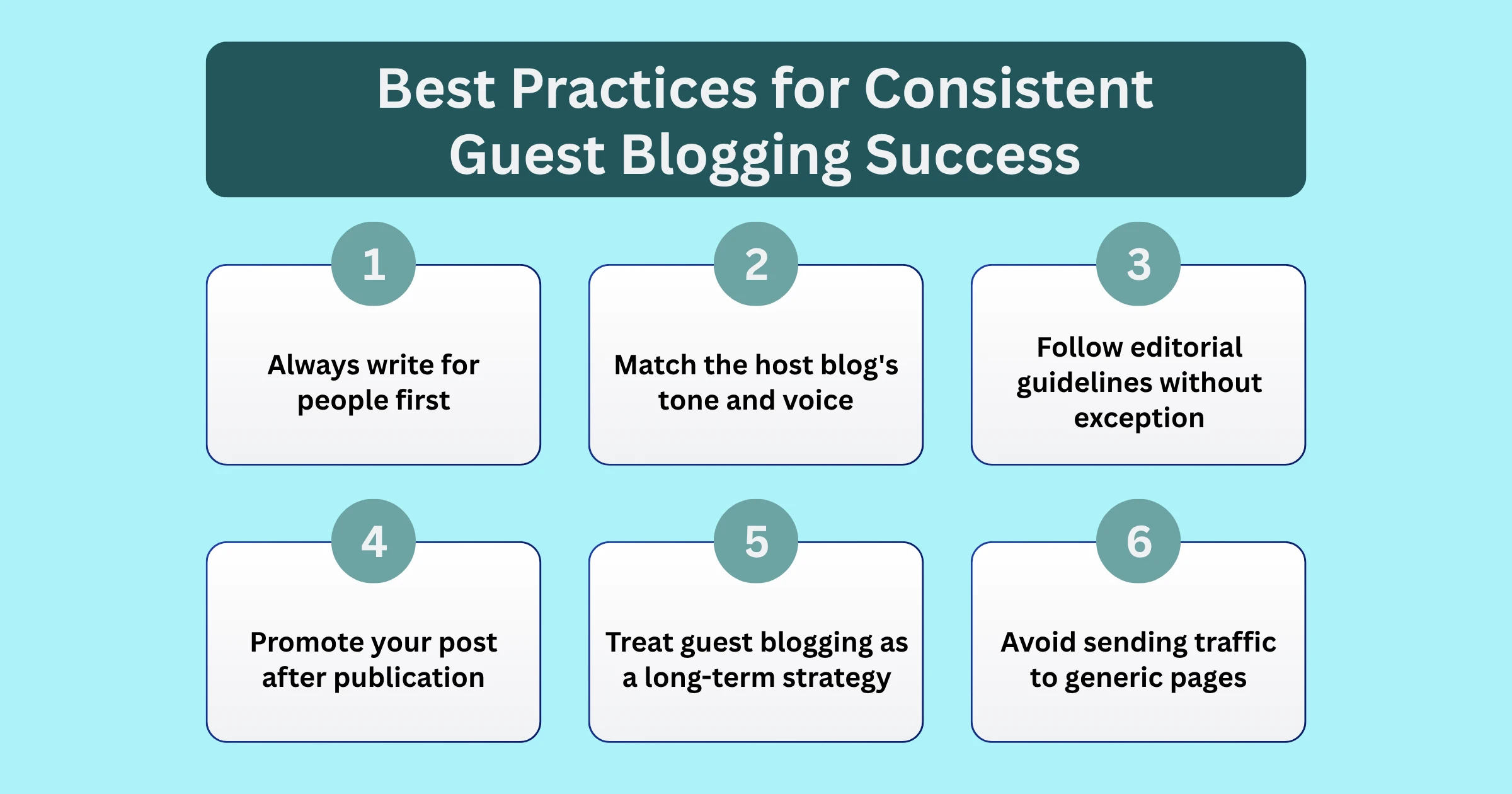
- Always write for people first: Search engine optimization is important, but it should never come at the expense of genuine usefulness. The most SEO-friendly content is content that people actually want to read, share, and link to. Write for your human reader first — and the SEO benefits will follow naturally. If you want to sharpen how your content performs in search after publication, optimizing your blog with AI SEO tools is a practical next step worth exploring.
- Match the host blog's tone and voice: Every publication has its own personality. Some are formal and academic; others are conversational and irreverent. Study the host blog’s existing content carefully and adapt your writing style to match their voice. A post that feels tonally out of place is less likely to be accepted and less likely to engage the host’s audience, even if the underlying content is strong.
- Follow editorial guidelines without exception: Guest post guidelines exist for good reason. They reflect what the editor knows works for their audience and their platform. Ignoring word count limits, formatting requirements, or linking policies signals disrespect for the editor’s time and dramatically reduces your chances of acceptance. Read the guidelines thoroughly and follow them precisely.
- Promote your post after publication: Do not treat publication as the finish line. Actively promote every guest blog post you publish: share it across your social media channels, feature it in your email newsletter, include it in your link-building outreach, and engage with every comment it receives. Getting this right comes down to understanding how to craft compelling CTAs for your blog — the difference between a reader who bounces and one who takes action is usually just one well-placed prompt.
- Treat Guest Blogging as a long-term strategy: The compounding power of guest blogging becomes most apparent over time. A single post might deliver a modest traffic spike. A consistent program of monthly guest blog posts, published across multiple relevant platforms over twelve to twenty-four months, builds a formidable backlink profile, a well-established industry reputation, and a steady stream of qualified inbound traffic. Commit to the long game — and make sure you're also aware of the dos and don'ts of blogging so the effort you invest holds up over time.
- Why generic pages kill conversions: A common and costly mistake is sending guest blog traffic to a generic homepage or a cluttered website with too many options and no clear direction. Visitors who arrive from a guest post arrive with a specific context and intent — shaped by the topic they just read about. When they land on a page that does not immediately reflect that context, they experience friction, lose momentum, and leave without taking action.
Common Guest Blogging mistakes SMBs should avoid
Even experienced content marketers can fall into traps that undermine their guest blogging results. Being aware of these common mistakes will help you avoid them and build a more effective program from the start.
- Pitching generic or promotional topics: Generic or overly promotional topics get rejected because they offer little value to the host audience. Pitch-specific, original ideas that solve real problems and bring fresh insight.
- Neglecting to promote the published post: Publishing isn’t the final step. Promoting your guest post expands its reach, supports the host publication, and increases the impact of your effort.
- Failing to track and measure results: Without tracking performance, guest blogging becomes guesswork. Monitor traffic, conversions, and backlinks to understand what works and improve future posts.
- Treating it as a one-off tactic: Guest blogging delivers results through consistency. Treat it as an ongoing strategy to build authority, reach, and long-term growth.
Conclusion
A well-crafted guest blog post is a powerful growth lever for SMBs, driving brand visibility, authority, quality backlinks, and qualified traffic without the recurring costs of paid ads. The businesses that see the best results treat guest blogging as a disciplined, long-term program—researching carefully, pitching strategically, creating original content, promoting actively, and measuring performance consistently. Start publishing strategically, stay consistent, and make every guest blog post work harder for your business.
Ready to turn your guest blogging efforts into a lead generation engine? Start building your blog hub on SubPage — and make every post work harder for your business. Try SubPage free today →
