How to Repurpose Product Documentation Into Blog Content
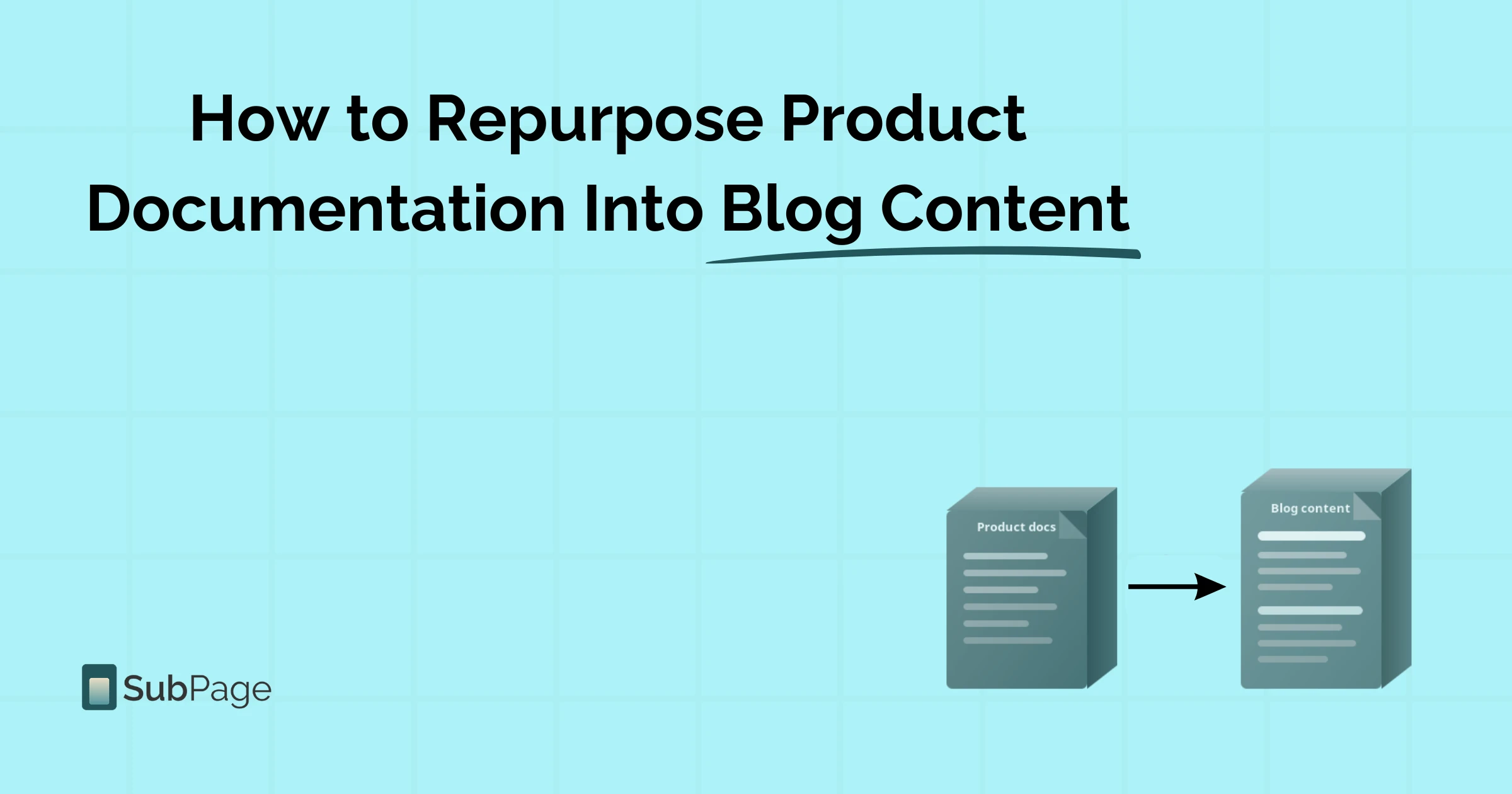
Most SaaS products already have detailed documentation covering features, setup, integrations, and troubleshooting. Yet most of it stays hidden inside help centers, seen only by existing users. This is a missed opportunity. Potential customers search Google for the exact problems your documentation solves — but help center content is written for users already inside the product, not structured or published in a way that reaches people still searching for a solution.
According to Forrester, 68% of buyers complete their own research before ever contacting sales. And across the SaaS industry, blog content consistently ranks as the top driver of organic traffic. The knowledge your team has already written is sitting one format shift away from reaching all of those readers.
Repurposing product documentation into blog content is a practical, scalable way to transform technical knowledge into discoverable, educational content — without starting from a blank page every time. Modern blogging platforms like SubPage allow teams to convert existing documentation URLs directly into blog drafts, dramatically reducing the effort it takes to publish new content.
Why Product Documentation is ideal for blog content
Documentation is not just a reference manual. It is a library of answers to real user questions, and that is precisely what makes it valuable as a blog source.
Every documentation article exists because a user needed to solve something specific. That means the topics are already validated — real people searched for them, asked about them, or got stuck on them. The content is written around real problems, which is exactly the foundation that search-optimized blog posts are built on.
Beyond that, documentation naturally follows step-by-step structures that blog readers respond well to. Tutorials, numbered processes, and before-and-after comparisons are all formats that perform strongly in organic search — and most documentation already uses them. Feature names, action verbs, and workflow descriptions embed keywords organically throughout, which means less SEO retrofitting when you adapt the content for a blog audience.
The types of documentation most ready to become blog posts include feature setup guides, integration tutorials, product workflows, troubleshooting instructions, and release explanations. These are formats with proven search demand and a natural fit for educational content.
The problem with documentation living only in Help Centers
Many companies maintain detailed product documentation but rarely use it as a content marketing asset. The result is a growing library of high-value content that only existing customers ever read.
The core tension is this: help center content is built for retention. Blog content is built for discovery. Most companies treat them as completely separate worlds — even when they are covering identical topics. The help center article titled "Setting Up the Notification Module" and the blog post titled "How to Automate Customer Alerts Without Code" could be the same piece of content. Instead, one gets written twice, inconsistently, by two different teams.
Common challenges that arise from this separation include help center articles rarely ranking for discovery-oriented keywords, documentation staying hidden from audiences who have not yet found the product, marketing teams rewriting the same information from scratch for blog posts, and maintaining two versions of the same content becoming increasingly inefficient as the product evolves. A broader SaaS content strategy that treats documentation and blog content as connected — not competing — is what closes this gap for most teams.
This is exactly where repurposing product documentation into blog posts creates real value — bridging the gap between what a team has already written and the audiences still waiting to find it.
What documentation-to-blog repurposing actually means
Documentation repurposing is the process of adapting existing resources — help center articles, product tutorials, integration guides, feature docs — into blog posts that target search queries and serve a broader educational audience.
It is not copy-pasting. It is restructuring. The same underlying knowledge gets reframed for a reader who has not purchased the product yet, rather than someone already inside it, trying to accomplish a specific task. A documentation page says, "Here is how to set up the Slack integration inside our product." A repurposed blog post says "how to connect your CRM with Slack and automate your team's workflow." Same information. Different framing. Completely different audience reach.
Instead of creating content from scratch, teams reuse existing knowledge and adapt it for SEO and broader audiences. The original technical accuracy stays intact — the delivery is what changes. This distinction matters because technical accuracy is often the hardest part of writing good product content. When it already exists in documentation, teams can focus entirely on the editorial layer.
The traditional way of turning documentation into blogs
Teams that do repurpose documentation typically follow a manual process. It works, but it is slow and repetitive — especially when documentation updates frequently.
The usual sequence involves copying the documentation content, rewriting it for a blog audience, adjusting the tone, reformatting headings, adding an introduction and conclusion, adding visuals, examples, and use cases, and then publishing in the blog CMS with optimized metadata.
Each step is reasonable on its own. But multiplied across dozens of documentation pages — and repeated every time the docs are updated — the process becomes a serious bottleneck. Content teams end up spending more time reformatting than actually writing. The highest-value editorial work, adding context, crafting narratives, and choosing the right examples, gets squeezed out by mechanical restructuring that a better workflow could eliminate.
The best types of documentation to repurpose into blogs
Not all documentation converts equally well. Five categories consistently produce the strongest blog content with the highest organic search potential.
- Feature tutorials: Documentation that walks users through a specific feature becomes a tutorial post targeting "how to" queries. A page titled "Using the Onboarding Module" becomes a blog post titled "How to Automate Customer Onboarding Without Writing a Single Line of Code" — targeting users in the research phase who have not yet chosen a tool.
- Integration guides: Integration guides are among the highest-value repurposing targets. Searches like "how to connect your CRM with [product]" attract users who are actively evaluating tools and comparing options. This content also supports partnership SEO, creating mutual value for both companies involved in an integration.
- Troubleshooting content: Users searching for solutions to specific errors are highly engaged and close to making decisions. Turning troubleshooting docs into problem-solving blog posts builds trust and captures bottom-of-funnel traffic that is often underserved by most SaaS companies.
- Workflow guides: Workflow guides that map a complete process from start to finish, target users seeking a full solution, not just a feature explanation. A reader searching "how to build an efficient project tracking system" wants to see the whole picture, and documentation that covers a complete workflow can deliver exactly that.
- Product updates and release notes: Release notes confined to a changelog reach only existing users. Adapted as feature spotlight blog posts, the same content communicates product momentum to potential customers and gives existing users a more readable narrative of what has changed and why it matters.
How repurposed documentation improves SEO
Turning product documentation into blog posts helps capture search traffic that help centers typically cannot reach, and the SEO benefits compound over time.
- Long-tail keyword targeting is one of the most immediate gains. Documentation is naturally full of specific, intent-driven phrases that match what real users type into search engines. Feature names, error messages, integration names, and workflow descriptions all represent queries with real volume and relatively low competition.
- Expanded topic coverage signals authority to search engines. A product that publishes forty blog posts covering the problems its features solve demonstrates topic depth in a way that a help center alone cannot. Internal linking between blog posts and documentation strengthens both, passing authority in both directions and guiding readers naturally through a content ecosystem.
- Tutorials consistently rank for the kinds of searches that convert. Queries beginning with "how to set up," "how to integrate," and "how to fix" represent users with clear intent and a specific problem to solve. These are exactly the searches that repurposed documentation can target, and they are consistently underserved by SaaS companies that have the answers buried in their help centers. Getting the SEO layer right is what makes this work — optimizing your blog with AI SEO tools is one of the fastest ways to close the gap between content that exists and content that actually ranks.
When repurposing, the most important SEO shift is in the title. Optimizing around how users search — focusing on outcomes rather than feature names — is the single change that most dramatically improves discoverability. "Set Up the Notification Module" becomes "How to Send Automated Customer Alerts Without Code."
Connecting blogs and documentation for a stronger content strategy
The most effective content strategy does not separate documentation and marketing content — it connects them. Each type serves a different part of the funnel, and linking them together amplifies the impact of both.
Blog posts explain use cases, benefits, and tutorials for users who are exploring and evaluating. Documentation provides technical depth for users who are implementing and using the product. Both pages link to each other, passing authority and guiding users naturally through the journey from discovery to activation. Understanding how the content marketing funnel works makes it much easier to see where documentation-turned-blog content fits — and which stage of the buyer journey each piece is actually serving.
SubPage makes it easier to manage both blogs and product content within the same publishing workflow, helping teams maintain consistency across their entire content library. Beyond the documentation repurposing workflow, SubPage's blogging platform is designed specifically to convert organic traffic into qualified leads — with built-in lead capture tools, newsletter signup forms, and analytics that show which blog posts are actually driving conversions. Blog content does not just attract readers; when built on the right platform, it turns those readers into a qualified pipeline.
A simple workflow to repurpose documentation
The practical process for SaaS teams comes down to five repeatable steps.
- Step one is identifying high-value documentation pages. Prioritize pages that cover popular features, common integrations, or frequently searched troubleshooting topics. Look at support ticket volume, help center search data, or simply the features most mentioned in sales calls.
- Step two is converting those pages into blog drafts. Using SubPage's URL conversion feature, teams generate an editable draft that preserves the original structure while opening it up for editorial work.
- Step three is optimizing blog titles for search. Reframe the title around how a new user would search for this topic — focus on the outcome or problem being solved, not the internal product feature name.
- Step four is adding examples, visuals, or use cases. Contextualize the technical content for a reader who has not used the product yet. Real-world examples and specific scenarios make the content credible and scannable.
- Step five is linking the blog back to the documentation. Include a link to the full documentation for readers who want deeper technical detail. This closes the loop between discovery content and implementation content, and it strengthens the internal linking structure across both.
Scaling content with documentation repurposing
Once the process is established, product documentation becomes a continuous, compounding source of blog content. Every new feature, integration, or release is a potential blog post. The documentation library that grows with the product also grows the blog content pipeline — without proportional effort.
Feature guides become tutorials, integration docs become co-marketable content, troubleshooting articles build long-tail coverage, and release notes become feature spotlights that communicate product momentum. For teams looking to get more out of every piece of content they produce, these SaaS content marketing tactics are worth exploring.
SubPage simplifies this scaling process by allowing teams to convert URLs into blog drafts and publish them quickly, without a separate CMS workflow for every piece of content. As the documentation grows, the blog content library grows with it.
How SubPage Makes This Workflow Faster
Manually converting documentation into blog posts means copying content, rebuilding structure, reformatting headings, adjusting tone, and then navigating a separate CMS to publish. Repeated across dozens of pages, that process consumes more time than most content teams have available. SubPage's blog builder is built specifically to remove that friction.
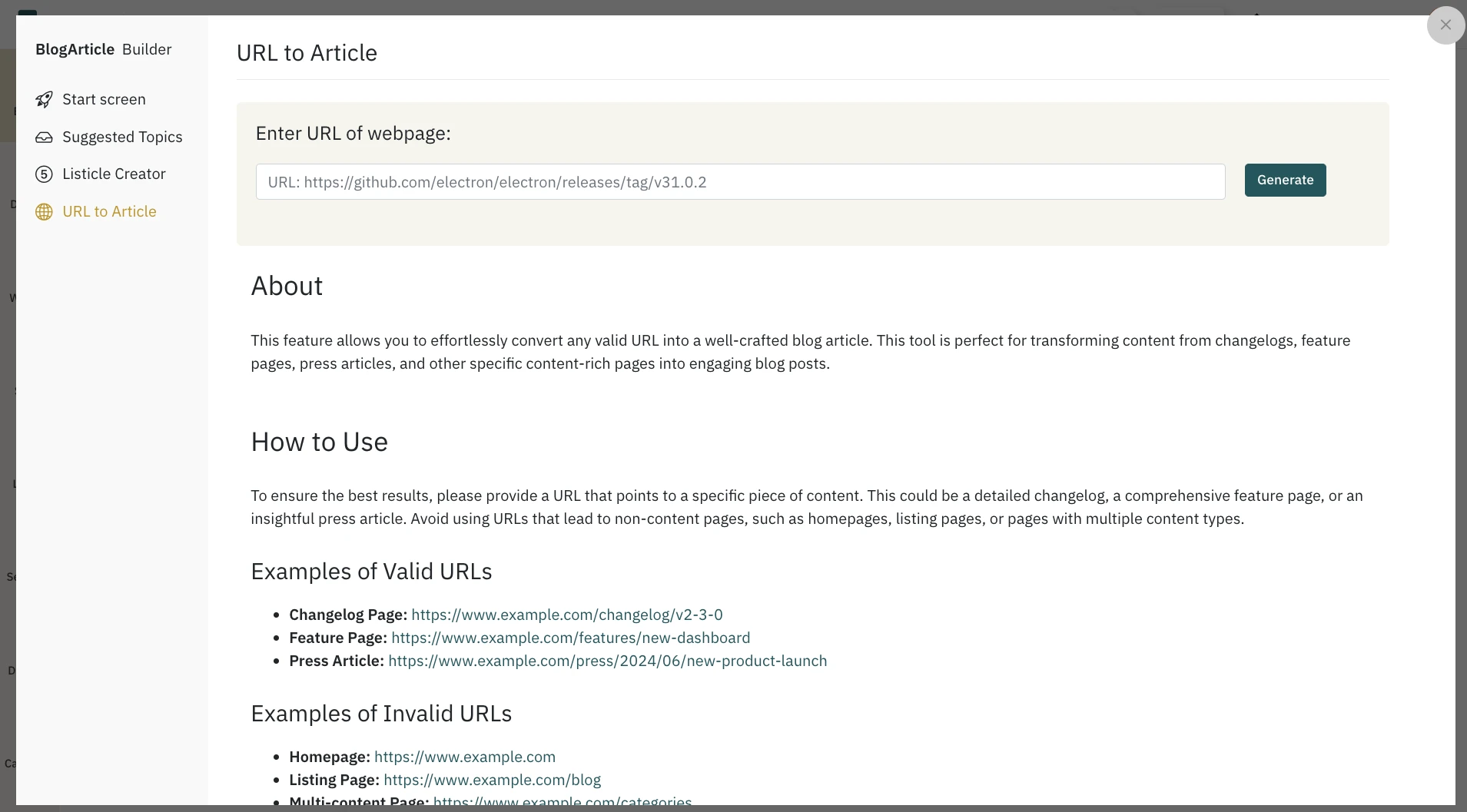
SubPage removes that friction with a built-in URL-to-Article feature inside the Blog Builder. Paste in the URL of any documentation page — a feature guide, integration tutorial, or troubleshooting article — and SubPage generates a complete, editable blog draft instantly. The original structure is preserved, the technical detail stays intact, and the content is immediately ready for editorial work.
No copying. No rebuilding from scratch. The whole repurposing workflow starts and ends in one place, so teams can focus on refining tone, adding context, and publishing — rather than reformatting content that already exists.
Conclusion
Repurposing product documentation into blog content is one of the most practical ways for SaaS teams to turn existing knowledge into a scalable growth channel. Instead of letting valuable content sit hidden inside help centers, teams can transform it into SEO-driven blog posts that reach potential customers earlier, strengthen overall content strategy, and continuously generate value from work they have already done.
With a platform like SubPage, the conversion process itself becomes faster — turning documentation URLs into publishable blog drafts so teams spend time on substance rather than reformatting. And once those posts are live, SubPage's lead capture and analytics tools ensure that blog traffic converts into a real, qualified pipeline.
Sign up for free and start turning your documentation into lead-generating blog content with SubPage today.
