21 Jul 2026
How to Build Topical Authority with a Business Blog

Most business blogs are built one keyword at a time, and most of them stay invisible. According to SEOmator, businesses with active blogs generate 67% more leads than those without one, making a well-structured blog one of the most valuable growth channels for businesses. Yet search engines reward websites that demonstrate expertise across an entire topic—not isolated blog posts. That's why building topical authority with well-structured content clusters is essential for improving search visibility and attracting sustainable organic traffic.
This guide explains how to build topical authority with a business blog and how SubPage helps you create SEO-friendly blog structures that are easier to organize, publish, and scale from day one.
What is topical authority?
Topical authority is the degree to which search engines and readers recognize your website as a comprehensive, trustworthy source on a specific subject — not just a page that happens to rank for one keyword. It's built by publishing a connected body of content that answers every meaningful question a reader might have, rather than a handful of disconnected posts chasing separate search terms.

A blog with strong topical authority doesn't just rank for "how to build topical authority." It also ranks for dozens of related questions a buyer or candidate might ask, because the site has demonstrably covered the subject in depth.
Topical authority vs topical relevance
These terms get used interchangeably, but they measure different things. Topical relevance is a page-level signal: how closely a single piece of content matches a search query. Topical authority is a domain-level signal: how completely your entire website covers a subject over time. A single optimized page can achieve topical relevance for one search. Only a structured content strategy — built around clusters, not one-off posts — builds topical authority.
Topical authority vs domain authority
Domain authority is a third-party metric that estimates a site's overall ranking strength, largely based on backlink volume and quality. Topical authority is subject-specific and is earned through content depth and internal linking rather than link acquisition alone. A newer or smaller site with modest domain authority can still outrank a much larger competitor on a specific topic if it covers that topic more thoroughly and links it together more clearly. This is good news for small businesses: you don't need a decade of backlinks to become the trusted source on your niche — you need a deliberate content strategy.
Why topical authority matters for a business blog
A business blog built for topical authority delivers benefits a random assortment of posts never will.
1. More durable rankings. Sites with well-developed topical coverage hold their positions better during algorithm updates, because authority isn't tied to a single page or keyword — it's distributed across a cluster.
2. Compounding growth. Early cluster articles are usually slowest to rank. Once a handful of connected pages go live and interlink, later posts inherit the established authority and gain visibility faster.
3. Lower cost per qualified visitor. A business blog with topical authority keeps attracting search traffic to older posts long after publication, compounding the return on your content strategy over time.
4. Stronger buyer and candidate trust. For SaaS companies and small businesses hiring selectively rather than in bulk, a blog that thoroughly covers hiring and workplace topics signals credibility to the exact audience reading it — whether that's a prospective customer or a candidate evaluating your career page.
5. Better visibility in AI-generated answers. Search engines and AI overview tools increasingly draw on sources that demonstrate consistent, well-linked expertise on a subject, making topical authority relevant to both traditional SEO and AI-driven discovery.
How to build topical authority with a business blog
Building topical authority is a structural exercise, not a writing exercise. Here's the process.
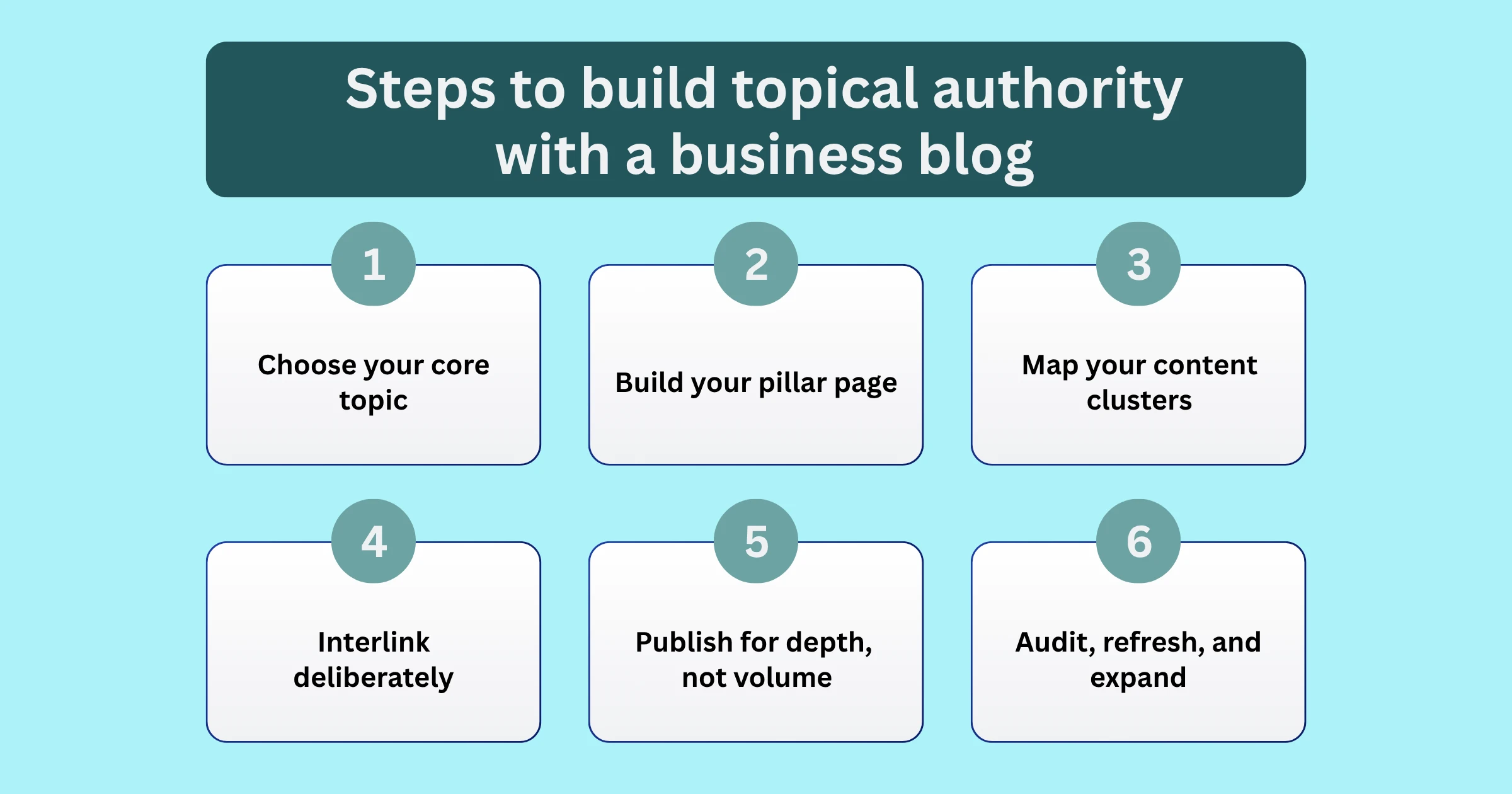
Step 1: Choose one core topic and define your audience
Start narrow. Pick a single core topic your business is genuinely positioned to speak on — for example, "hiring for small teams" or "SaaS recruitment." Trying to cover too many unrelated subjects at once is the most common reason business blogs never develop authority in any of them.
Step 2: Build a pillar page as your topic hub
A pillar page is a comprehensive overview of your core topic that links out to every supporting article in the cluster. Think of it as the front door to the subject — broad enough to rank for the head term, but structured so every subtopic has its own dedicated, linked-to page. Your blog's homepage or a dedicated hub article can serve this role.
Step 3: Map your content clusters
Break the core topic into subtopics — the specific questions your audience searches for. For a hiring-focused business blog, that might include applicant tracking, candidate experience, career page design, and interview process. Each subtopic becomes a cluster article linking back to the pillar page and sideways to related articles. This structure is what separates a real SEO content strategy from a list of blog ideas.
Step 4: Interlink deliberately
Every new post should link to two or three related articles already on your blog, and older posts should be updated to link to relevant new ones. Internal linking signals topical relevance at the page level, while the accumulated network builds topical authority at the domain level — and it keeps readers moving through your site instead of leaving after one article.
Step 5: Publish for depth, not volume
Ten thoroughly researched articles that fully answer a subtopic will outperform fifty thin posts written to hit a word count. Each article should aim to be the most complete answer available for its question, not another entry competing on keyword density.
Step 6: Audit, refresh, and expand
Topical authority isn't a one-time project. Revisit older cluster content quarterly, update statistics and examples, and add articles as new subtopics emerge in your industry. Search visibility rewards freshness almost as much as depth.
Common mistakes that prevent topical authority
Even well-intentioned business blogs stall for predictable reasons:
- Publishing across unrelated topics instead of committing to one subject long enough to build depth.
- Skipping internal links between related posts, leaving each article to rank — or fail to rank — alone.
- Treating the blog as a one-off task rather than an ongoing content strategy with a cadence.
- Chasing keyword volume instead of answering the specific questions your audience is asking.
- Never updating older posts, letting outdated statistics quietly erode trust and rankings.
Build topical authority with SubPage
A business blog only builds topical authority if it's structured for it from the start — pillar pages, clear categories, and internal links that connect cluster content automatically. SubPage's blog publisher is built for exactly this kind of structured content strategy: it handles clean URLs, sub-directory publishing, built-in SEO reporting, and AI-assisted outlines, so your team can focus on covering a topic thoroughly instead of managing the technical side of blog SEO.
Whether you're building your first pillar page or mapping out a full hiring content cluster, a blog platform designed around SEO fundamentals makes the structural work far easier to maintain quarter over quarter.
Conclusion
Topical authority rewards the businesses willing to go deep on one subject instead of wide across many. For small businesses and SaaS hiring teams, that means a blog built around a clear content strategy — pillar pages, mapped content clusters, and deliberate internal linking — can outperform far bigger competitors on the topics that matter most to your audience, whether that's product education or hiring and recruitment.
If you're ready to structure your blog the right way from the start, sign up for SubPage for free and start building your first content cluster today.
FAQs about building topical authority with a business blog
How do you build topical authority for SEO?
Choose one core topic, build a pillar page as its hub, break the subject into subtopic clusters, interlink every article deliberately, and publish consistently while refreshing older content.
How do you create topical authority using blog content?
Publish a connected series of articles that each answer a distinct subtopic, then link them together so search engines and readers can see the full scope of your coverage.
What's the difference between topical authority and domain authority?
Domain authority estimates overall site strength based largely on backlinks. Topical authority is subject-specific, earned through content depth and internal linking rather than links alone.
How do you organize blog content into topic clusters?
Start with a pillar page, identify the specific questions readers ask within that topic, write a dedicated article for each one, and link every cluster article back to the pillar and to related articles.
Is topical authority only relevant for large websites?
No. Smaller sites can outrank larger competitors on a specific subject by covering it more completely and linking it more clearly than a broader, less focused site does.
How long does it take to build topical authority?
Early cluster content is usually slowest to rank. Once several interlinked articles are live, later posts gain visibility faster by inheriting authority from the cluster — most businesses see meaningful movement within three to six months of consistent publishing.
Share: