How Product Updates Improve Customer Retention?
Retention is the metric that quietly decides whether a SaaS company survives or stalls. Acquiring a new customer is expensive, but keeping an existing one largely depends on a simple, often overlooked habit: showing them that the product they pay for keeps improving. According to Bain & Company, increasing customer retention by just 5% can increase profits by 25% to 95%, depending on the industry. That single statistic explains why so many product and marketing teams are shifting their attention from acquisition funnels to retention loops — and product updates sit right at the center of that shift.
When customers see consistent, well-communicated improvements, they feel like partners in the product's growth rather than passive users waiting for something to break. This article breaks down how product updates improve customer retention, what a sound product communication strategy looks like, and how a tool like SubPage makes it possible to run this strategy without slowing down your product or engineering team.
Why product updates and customer retention are connected
Customer retention rarely fails because of one dramatic event. It fails gradually, through small moments of disengagement — a user who stops noticing value, forgets why they signed up, or assumes the product has stagnated. Product updates interrupt that slow drift.

Every time you ship something and communicate it clearly, you are reminding the customer of three things: the product is actively maintained, their feedback matters, and there is more value waiting to be discovered. This is the foundation of product-led growth, where the product itself — not just sales or support — becomes the primary driver of retention and expansion.
Customer lifecycle management depends on this kind of reinforcement at every stage. A new user needs to see early wins. A mid-lifecycle user needs to see continued momentum. A long-tenured user needs proof that switching to a competitor would mean leaving behind a product that is still evolving in their favor. Product updates serve all three audiences differently, but they all rely on the same underlying signal: visible progress.
Feature announcement best practices
Shipping a feature is only half the job. If users do not know it exists, it cannot influence retention at all. Strong feature announcement best practices share a few common traits.
Keep a single source of truth
Announcements that open with "we re-architected our backend" lose readers immediately. Announcements that open with "you can now export reports in one click" get read and acted on. Always translate engineering work into a benefit that the user can recognize in their own workflow.
Match the channel to the size of the update
A minor bug fix does not need an email blast. A major feature deserves more than a single line in a changelog. Calibrate the communication channel — in-app banner, email, changelog entry, or blog post — to the size of the change.
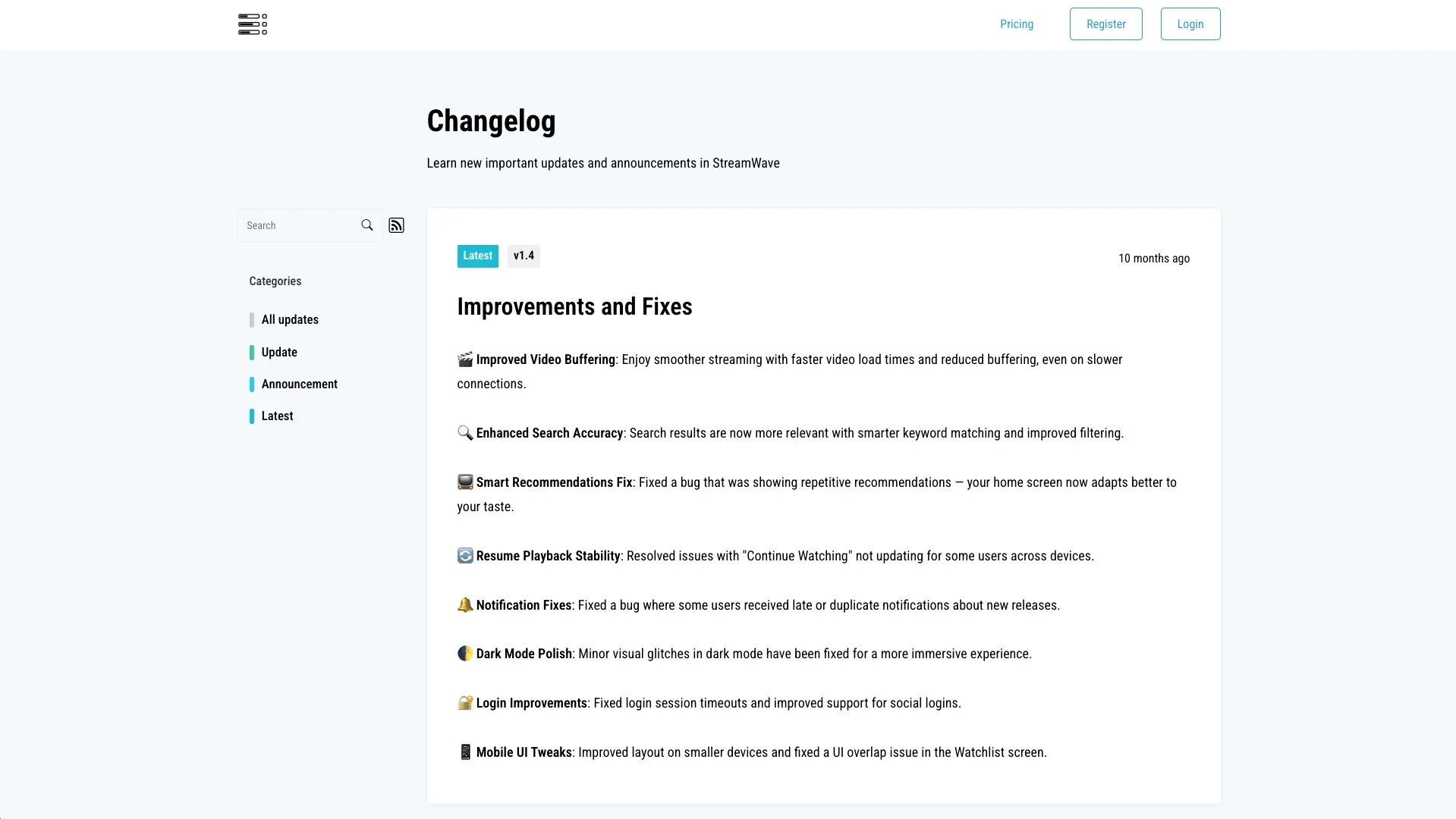
Many SaaS teams announce updates across Slack communities, social media, emails, and in-app messages, but only some of those channels stay current. A centralized changelog acts as the canonical record that every other channel can point back to. This is one of the core reasons a public changelog has become a standard part of SaaS communication rather than a nice-to-have.
A customer who half-remembers a feature should be able to search or scroll a changelog and confirm it. Buried announcements that only existed for a day in a social feed do not support this kind of recall.
How to announce product updates effectively
How to announce product updates is less about creative flair and more about consistency and clarity. A few practical guidelines apply across most SaaS products.
Write for skimmers first. Most users scan rather than read, so lead each entry with a clear, benefit-driven headline. Categorize every update — feature, fix, improvement, or deprecation — so customers can quickly judge relevance. Include a visual whenever the change has a visual component, since screenshots and short clips communicate UI changes faster than text. Publish on a predictable schedule, whether that is weekly or biweekly, since irregular communication reads as inconsistency even when the underlying product work is steady. And always close the loop on requested features, crediting the customers or segments who asked for them whenever possible.
This is also where feature release communication intersects with customer support. A well-documented release reduces the volume of "what changed?" tickets because customers can self-serve the answer instead of opening a support thread.
Product communication strategy: building the system
A one-off announcement is easy. A sustainable product communication strategy is harder because it requires coordination across product, engineering, marketing, and support.
The strongest systems share a similar structure. Product management logs changes as they ship, rather than reconstructing a list right before release day. A single person or small team owns the voice and tone of customer-facing copy, so updates do not read like raw commit messages. Updates route through one central hub and then fan out to other channels like email, in-app widgets, and social posts. And the team tracks which updates drove the most engagement, using that data to refine future announcements.
Manually keeping every channel in sync this way is where most teams lose consistency. This is exactly the gap a platform like SubPage was built to close.
How SubPage strengthens your retention strategy
User engagement product updates: turning a release into a retention moment
Not every update needs to be a major launch to influence engagement. Small, frequent updates often do more for retention than a handful of large ones each year, because they signal ongoing attention rather than sporadic effort.
A few ways product teams can convert routine releases into user engagement product updates:
Segment your announcements by user behavior, so that only customers who would benefit from a specific feature see it surfaced prominently. Use in-app visibility for top-of-mind awareness rather than relying solely on email, since email open rates continue to decline across SaaS audiences. Tie the new releases back to a feedback loop wherever possible, explicitly noting when a feature was shaped by user requests. And revisit underused features periodically, since many valuable features go unnoticed simply because they launched without enough visibility the first time.
This feedback loop is worth emphasizing on its own. A user feedback loop that closes — where customers see their suggestions reflected in real releases — builds a stronger sense of ownership than almost any other retention tactic, because it shifts the relationship from vendor-and-customer to collaborator-and-product.
Customer retention techniques beyond the changelog
While changelogs and in-app announcements are central to a product update strategy, a few additional customer retention techniques work well alongside them.
Onboarding sequences that reference recent updates help new users see the product as current rather than static. Customer success check-ins that walk through recently shipped features can re-engage accounts that have gone quiet. And blog content that explains the reasoning behind major updates gives prospects and customers a deeper view of product direction than a changelog entry alone can provide. Teams building this kind of supporting content often find it useful to look at how SaaS companies use blog content to educate users, since the same principles that drive educational content also strengthen update communication.
How often should you send product updates?
There is no universal cadence, but most SaaS teams find a workable rhythm somewhere between weekly and biweekly for changelog entries, with monthly or quarterly summaries for customers who prefer a lower-frequency digest. The goal is regularity, not volume. A team that publishes consistently every two weeks builds more trust than one that publishes ten updates in a single week and then goes silent for two months.
Ways to reduce churn with product updates
Reducing churn through product updates comes down to consistency, visibility, and relevance. Publish regularly enough that customers expect to see something new. Make updates visible inside the product, not just in an inbox that may go unread. Tie releases to the specific problems your highest-risk segments have raised. And always frame updates around the outcome for the user, not the effort behind the scenes.
Churn reduction strategies that rely entirely on discounts or win-back campaigns tend to treat the symptom rather than the cause. Product updates address the cause directly: they remind customers why they chose the product in the first place, and show them it has only gotten better since.
Conclusion
Product updates are among the simplest, most direct levers SaaS teams have to improve customer retention. The strategy does not require a large team — it requires consistency, clear communication, and a system that keeps every channel in sync.
Start building your changelog with SubPage today and turn every release into a reason for customers to stay.


